How Much Does a Payday Loan Really Cost? APR Calculator, Fees and Credit Impact
By TCA Financial Editorial Team. Last reviewed: October 25, 2026.
Disclosure: TCA Financial (tcaloans.com) is not a lender and does not make credit decisions. We connect people with independent lenders and may be paid by those lenders for advertising. This guide is general information, not financial or legal advice.
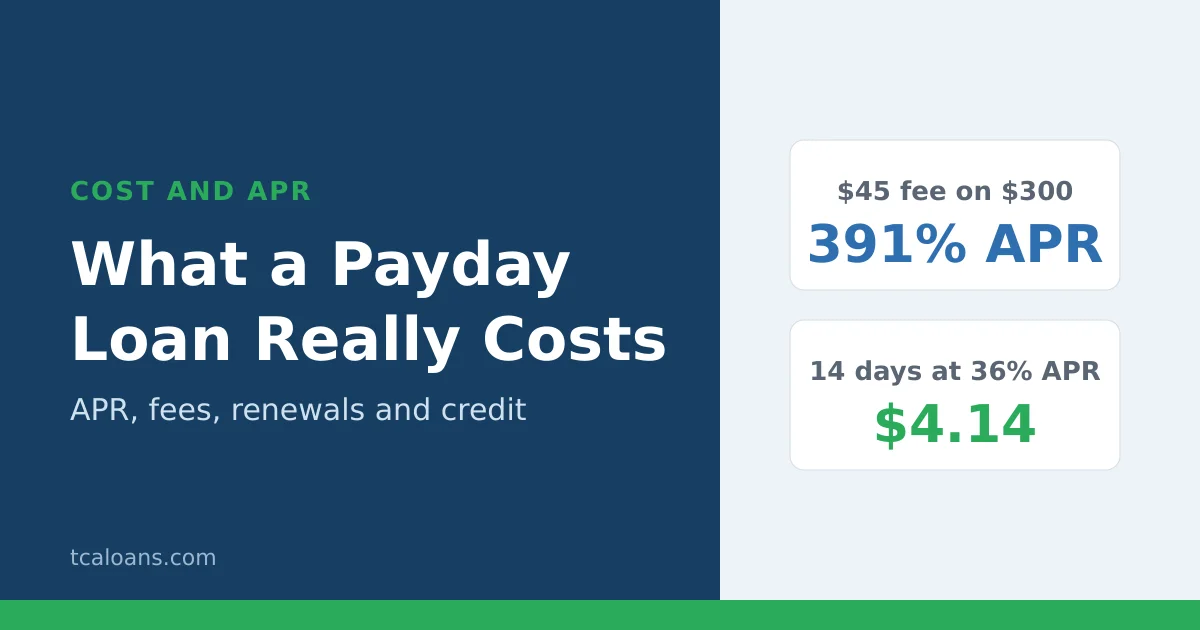
Short answer: A payday loan usually costs $10 to $30 for every $100 borrowed, according to the Consumer Financial Protection Bureau (CFPB). On a typical two week loan, a $15 per $100 fee works out to an APR of about 391%. Borrow $300 and you repay $345 two weeks later. The real cost climbs when the loan is renewed or reborrowed: each renewal adds another fee while the original amount is still owed. Use the calculator below to price your own loan.
Key points
- Typical fee: $10 to $30 per $100 borrowed; $15 per $100 for 14 days is about 391% APR (CFPB).
- APR lets you compare a payday loan with a credit card, a credit union loan or any other credit on the same yearly scale. Lenders must disclose it before you sign.
- Most of the cost comes from repeat borrowing. The CFPB found that over 80% of payday loans are rolled over or followed by another loan within 14 days (CFPB Data Point, 2014).
- State law sets the maximum fee. The same $300, 14 day loan costs $30 in Rhode Island, $60 in North Dakota and about $4 in a state with a 36% APR cap.
- Payday loans are generally not reported to the three nationwide credit bureaus, so on time payments do not build credit. A debt sent to collections can still show up on your report (CFPB).
Payday loan APR calculator
Enter the amount you receive, the fee in your loan agreement and the number of days until it is due. To see a state’s legal maximum fee, pick the state from the list. Add renewals to see what happens when the loan is not repaid on the first due date.
Payday loan APR calculator
Enter a loan, or pick a state to load its legal fee cap. Results are estimates for a single payment loan; your lender’s contract is what counts.
| Same amount and time, priced at | Cost | You save |
|---|
APR = (fee / amount) / days x 365 x 100, the method federal Truth in Lending rules use for single payment loans. Comparison rows use simple interest at the stated APR. 28% is the NCUA cap for credit union Payday Alternative Loans; 36% is the cap many states use.
How payday loan APR is calculated
The annual percentage rate is the cost of credit expressed as a yearly rate (12 CFR 1026.22), and federal Truth in Lending rules require lenders to disclose it before you agree to the loan (12 CFR 1026.18). For a single payment payday loan the math is short:
APR = (fee / amount borrowed) / days in the term x 365 x 100
Worked example from the CFPB: a $15 fee on a $100 loan due in 14 days. $15 / $100 = 0.15. 0.15 / 14 = 0.0107 per day. 0.0107 x 365 = 3.91, or about 391% APR.
The fee looks small because it is charged for two weeks, not a year. A $15 fee every two weeks, kept up for a year, is $390 in fees on a $100 loan. That is why APR, not the fee, is the right number for comparing payday loans with other credit.
Fee per $100 and the APR it equals
| Fee per $100 | 14 day term | 30 day term |
|---|---|---|
| $10 | 261% | 122% |
| $15 | 391% | 182% |
| $17.5 | 456% | 213% |
| $20 | 521% | 243% |
| $30 | 782% | 365% |
A longer term lowers the APR for the same fee, so always compare loans with the same term, or compare APRs.
What a $300 payday loan costs by state
Each state that allows payday loans sets its own fee cap, and some states cap the APR so low that payday pricing is not possible. The table shows the maximum legal fee for $300 received for 14 days, based on our payday loan laws by state guide, which links every figure to the state statute and regulator.
| State | Maximum fee rule | Fee on $300 | Total repaid | APR (14 days) |
|---|---|---|---|---|
| Rhode Island | 10% of the amount advanced (payday authority ends Jan 1, 2027) | $30.00 | $330.00 | 261% |
| Florida | 10% plus up to $5 verification fee | $35.00 | $335.00 | 304% |
| Kansas | 15% of the amount advanced | $45.00 | $345.00 | 391% |
| South Carolina | 15% of the amount advanced | $45.00 | $345.00 | 391% |
| Washington | 15% of the first $500 | $45.00 | $345.00 | 391% |
| Alaska | 15% plus up to $5 origination fee | $50.00 | $350.00 | 435% |
| Alabama | 17.5% of the amount advanced | $52.50 | $352.50 | 456% |
| North Dakota | 20% of the amount advanced | $60.00 | $360.00 | 521% |
| California | 15% of the check; check max $300, so $255 cash | $45.00 | $300.00 (on $255) | 460% |
| Tennessee | 15% of the check, fee included in the $500 limit | $52.94 | $352.94 | 460% |
| 36% APR cap states (Colorado, Illinois, Montana, Nebraska, New Hampshire, South Dakota) | 36% APR | $4.14 | $304.14 | 36% |
These are legal maximums for a single loan. Some states also limit how many loans you can have open, add database fees, or require a payment plan option. Texas, Utah, Nevada, Idaho, Delaware and Wisconsin set no fixed fee cap in statute, so the price there depends on the lender. See the state guide for those details.
Why renewals and reborrowing drive the real cost
A payday loan is designed to be repaid in one payment on your next payday. When that payment would leave you short, many borrowers pay only the fee and renew the loan, or repay it and take a new one right away. The CFPB studied millions of storefront loans and found (CFPB Data Point: Payday Lending, March 2014):
- Over 80% of payday loans were rolled over or followed by another loan within 14 days.
- 15% of new loans were followed by a sequence of at least 10 loans.
- Half of all loans were part of a sequence at least 10 loans long.
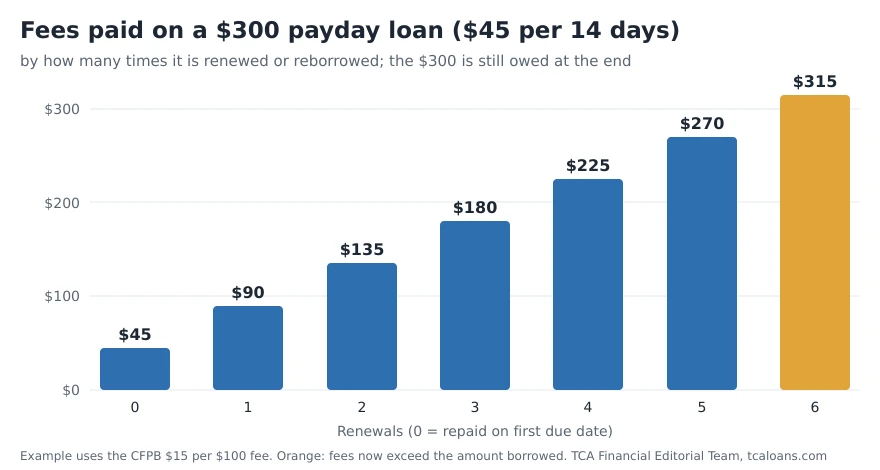
Using the CFPB example of $45 on $300: repay on time and the loan costs $45. Renew it four times and you have paid $225 in fees over 10 weeks and still owe the $300. After six renewals the fees ($315) are more than the amount you borrowed. Many states limit or ban renewals for exactly this reason; the calculator flags it when a state preset does not allow the number of renewals you enter.
Costs that are not in the APR
The APR covers the finance charge. A loan that is not repaid as planned can add more:
- Bank fees. In a CFPB study of online payday and similar loans, half of the bank accounts with these payments had at least one payment request that caused an overdraft or failed for non-sufficient funds within 18 months. Those accounts were charged an average of $185 in overdraft and NSF fees (CFPB, Online Payday Loan Payments, 2016).
- Lender late and returned payment fees. A failed payment can bring a late fee and a returned payment fee from the lender as well as an NSF fee from your bank (CFPB).
- Collections. An unpaid loan may be sent or sold to a debt collector. See what debt collection might mean for your credit.
You can stop a lender from taking automatic electronic payments from your account, but you still owe the balance (CFPB). Also check how your payment is set up: the CFPB notes that some lenders schedule only a renewal fee on the due date, so you may need to act several days early to pay the loan off in full (CFPB).
How payday loan costs compare with other options
Same $300, priced for 14 days where the product allows it:
| Option | Rate or fee basis | Cost on $300 | Source |
|---|---|---|---|
| Payday loan, $15 per $100 | About 391% APR | $45.00 for 14 days | CFPB |
| Credit card balance | 22.36% average APR on accounts assessed interest (Aug 2026) | $2.57 for 14 days | Federal Reserve G.19 |
| Credit union Payday Alternative Loan (PAL) | Up to 28% APR plus an application fee of no more than $20; term at least 1 month | $6.90 interest for 1 month, up to $26.90 with the maximum fee | 12 CFR 701.21, NCUA |
| Loan in a 36% APR cap state | 36% APR | $4.14 for 14 days | State law (see the state guide) |
Credit union PALs are $200 to $1,000 for 1 to 6 months (PAL I) or up to $2,000 for up to 12 months (PAL II), and you usually need to be a member. Active duty servicemembers and their dependents are covered by the Military Lending Act, which caps the military APR at 36% and covers payday loans (32 CFR 232.4, CFPB).
Do payday loans affect your credit?
Usually not directly, in either direction. According to the CFPB:
- Payday loans are generally not reported to the three nationwide credit reporting companies, so on time payments are unlikely to raise your score or help you build credit.
- Some payday lenders check specialty consumer reporting companies instead of the big three.
- If the debt is sent or sold to a debt collector, the collector could report it to a nationwide credit bureau, and a court judgment over the loan could also appear on your reports.
If your goal is to build credit, a product that reports to the bureaus does more. See credit report basics.
How to keep the cost down
- Check the APR and the total of payments on the disclosure before you sign, and compare it with the state maximum in the table above.
- Borrow only what you need: the fee grows with the amount.
- Plan the repayment from the paycheck it is due on. If that would leave you short for rent or food, consider a cheaper option first.
- Make sure the payment on the due date pays the loan in full, not just a renewal fee.
- If you cannot repay, ask the lender about an extended payment plan. Several states require lenders to offer one.
- Ask your bank or credit union about a small dollar loan or a PAL before you need the money.
Comparing offers through TCA Financial
If you decide a short term loan is right for you, you can use our loan request form to be connected with independent lenders. Rates, fees and terms are set by the lender and depend on your state and situation; review the lender’s APR disclosure before you accept. Our service is not available in Arkansas, New York, Vermont or West Virginia.
Frequently asked questions
How much does a $500 payday loan cost?
At the common $15 per $100 fee, a $500 loan costs $75 for two weeks, so you repay $575. That is about 391% APR. Your state may set a lower or higher maximum, and several states do not allow a $500 payday loan at all.
What is the average APR on a payday loan?
Fees of $10 to $30 per $100 for two weeks equal roughly 261% to 782% APR. The CFPB uses $15 per $100, about 391%, as the typical example. States with a 36% cap keep loans far below that.
Why is the APR so much higher than the fee?
The fee is charged for about two weeks. APR shows what that same fee would be as a yearly rate, so a 15% two week charge becomes about 391% per year.
Can I pay off a payday loan early?
Ask the lender before you sign. Check whether your payment is set up to pay the full balance or only a renewal fee, since the CFPB notes some lenders schedule only the fee by default.
Does a payday loan help build credit?
Generally no. Payday loans are usually not reported to the three nationwide credit bureaus, so paying on time does not build a credit history there. Unpaid debt that goes to collections can hurt it.
Is there a federal cap on payday loan APR?
Not for most consumers. The Military Lending Act caps the military APR at 36% for active duty servicemembers and their dependents. Other limits come from state law.
Related reading
- Payday loan laws by state (2026)
- Are payday loans worth the cost?
- What debt collection might mean for your credit
Sources
- CFPB, What is a payday loan?
- CFPB, What are the costs and fees for a payday loan?
- CFPB, Why is the APR higher than the interest rate for my payday loan?
- CFPB, Data Point: Payday Lending (March 2014)
- CFPB, Online Payday Loan Payments (April 2016)
- CFPB, Can taking out a payday loan help rebuild my credit?
- CFPB, Late fees and NSF fees on payday loans
- CFPB, How can I stop a payday lender from taking money out of my account?
- CFPB, How do I repay a payday loan?
- FTC, What to know about payday and car title loans
- Federal Reserve, G.19 Consumer Credit (October 7, 2026 release)
- 12 CFR 701.21 (NCUA Payday Alternative Loans)
- NCUA Letter 26-FCU-02, permissible loan interest rate ceiling
- 12 CFR 1026.18 (Regulation Z disclosures)
- 12 CFR 1026.22 (determination of APR)
- 32 CFR 232.4 (Military Lending Act)
- CFPB, What is covered under the Military Lending Act?
State fee limits come from the statutes and regulators linked in our payday loan laws by state guide. Last reviewed October 25, 2026 by the TCA Financial Editorial Team. Found an error? Email support@tcaloans.com.