Payday Loan Statute of Limitations in Texas: How Long Can They Sue You?
By TCA Financial Editorial Team. Last reviewed: October 26, 2026.
Disclosure: TCA Financial (tcaloans.com) is not a lender and does not make credit decisions. We connect people with independent lenders and may be paid by those lenders for advertising. This guide is general information about Texas and federal law, not legal advice. If you have been sued or a deadline matters, talk to a Texas lawyer or a legal aid office.
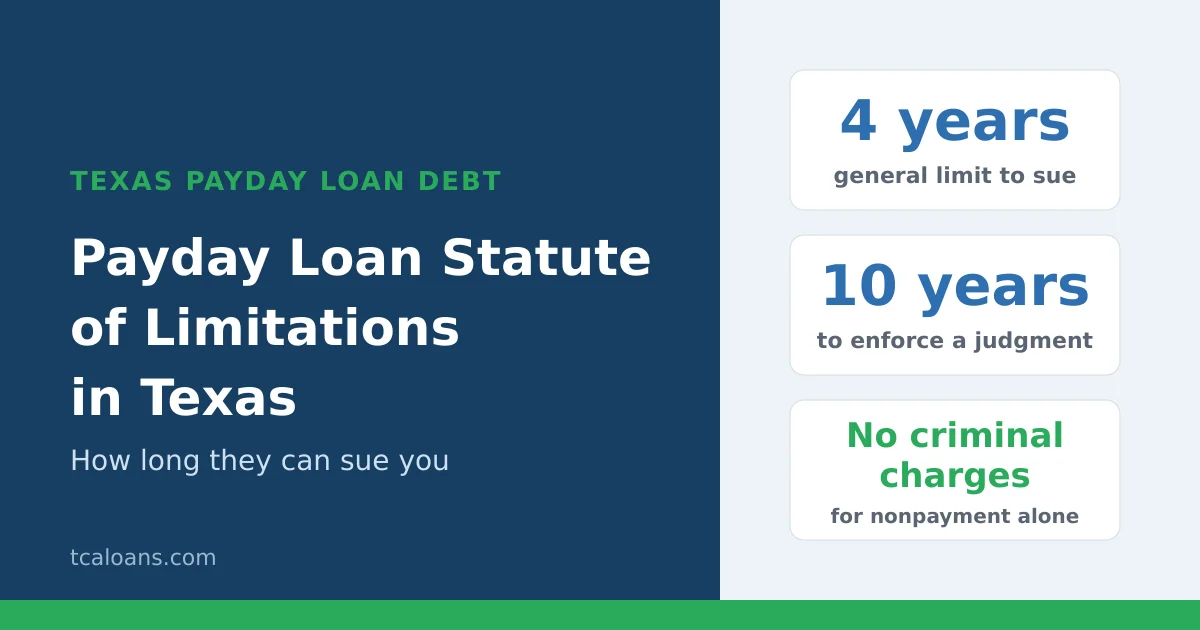
Short answer: In Texas, a lender or debt collector generally has four years to sue you over an unpaid payday loan. The four years run from the day the claim “accrues,” which for a payday loan is usually when you default (Tex. Civ. Prac. & Rem. Code 16.004(a)(3)). After that, a debt collector may not sue you or threaten to sue you (12 CFR 1006.26(b)). The debt does not disappear, though: collectors can still ask you to pay, and the account can stay on your credit report for up to about seven and a half years from the date you first fell behind.
Key points
- Texas sets a four year limit for lawsuits on a “debt” (CPRC 16.004). Some payday loans are signed as promissory notes, and a negotiable note can have a six year limit (Bus. & Com. Code 3.118).
- An old debt is not revived just by talking about it. In Texas, an acknowledgment only counts against you if it is in writing and signed (CPRC 16.065), and for debts owned by a debt buyer, even a payment does not revive a time-barred claim (Tex. Fin. Code 392.307(d)).
- If you are sued after the deadline, the statute of limitations is a defense you need to raise. Ignoring the lawsuit can lead to a default judgment even on an old debt.
- A Texas judgment can be enforced for 10 years and can be renewed (CPRC 34.001), but current wages cannot be garnished for a payday loan (Tex. Const. art. XVI, sec. 28).
- Nobody may threaten or pursue criminal charges over the check or debit authorization you gave for a Texas payday loan, unless there was forgery, fraud, theft or other criminal conduct (Tex. Fin. Code 393.201(c)(3)).
How payday loans work in Texas
Most Texas payday loans are arranged through a “credit access business.” The Texas Office of Consumer Credit Commissioner (OCCC) explains that the business obtains the loan for you from an independent third party lender and charges its own fee for doing so. You sign a promissory note with the lender and a separate credit services agreement with the credit access business, and you usually make your payments to the credit access business (OCCC, Credit Access Businesses).
That matters for collections because you may owe two parties: the lender on the note and the credit access business under its agreement. Credit access businesses must follow the Texas debt collection law in chapter 392 of the Finance Code and the federal Fair Debt Collection Practices Act when they collect (Tex. Fin. Code 393.201(c)).
The Texas statute of limitations for payday loans
Section 16.004(a) of the Texas Civil Practice and Remedies Code says a person “must bring suit” on an action for “debt” “not later than four years after the day the cause of action accrues” (CPRC 16.004). An unpaid payday loan is a debt, so four years is the general rule.
When does the four year clock start?
The clock starts when the cause of action accrues. For a payday loan that is usually the date you miss the payment and the loan goes into default, but the exact date can depend on your contract, for example if the lender accelerated the balance on a later date. The CFPB notes that the start date varies by state and can be affected by the terms of your credit agreement (CFPB). Keep your loan papers and bank statements so you can show when you stopped paying.
Four years or six years?
Texas also has a separate limit for negotiable instruments. An action to enforce a note payable at a definite time must be brought within six years after the due date, or after an accelerated due date (Bus. & Com. Code 3.118(a)). Because Texas payday borrowers sign a promissory note with the lender, a collector could argue for the six year period. Whether a particular payday note is a negotiable instrument is a legal question. Texas lawmakers referred to both limits in the debt buyer law, which bars suits after the period in “Section 16.004, Civil Practice and Remedies Code, or Section 3.118, Business & Commerce Code” (Tex. Fin. Code 392.307(c)). If a collector sues you between year four and year six, get legal advice before you answer.
Can a payment restart the clock in Texas?
Nationally, the CFPB warns that “making a partial payment or acknowledging you owe an old debt, even after the statute of limitations expired, may restart the time period” in some states (CFPB). Texas law gives you two protections:
- An acknowledgment of a debt that appears to be barred by limitations only counts against you if it is “in writing and is signed by the party to be charged” (CPRC 16.065). Saying on the phone that you owe the money is not enough.
- If a debt buyer owns the debt and the limitations period has run, the claim “is not revived by a payment of the consumer debt, an oral or written reaffirmation of the consumer debt, or any other activity on the consumer debt” (Tex. Fin. Code 392.307(d)).
Even so, do not sign anything that admits an old debt or promises to pay it until you know its date and who owns it.
Timeline: what can happen and when
| Time after default | What the law allows | Source |
|---|---|---|
| Right away | Collection calls and letters, within the limits of state and federal collection law. A debt collector must send you validation information, and you have about 30 days to dispute the debt. | 12 CFR 1006.34; Tex. Fin. Code ch. 392 |
| Up to 4 years | The lender, credit access business or a debt buyer can sue you for the debt. | CPRC 16.004 |
| 4 to 6 years | A suit may be time-barred. A collector might argue for the 6 year note limit; get legal advice. | Bus. & Com. Code 3.118 |
| After the limit runs | No lawsuit or threat of a lawsuit by a debt collector. A debt buyer must tell you in writing it will not sue you. Collectors may still ask you to pay. | 12 CFR 1006.26; 392.307(e) |
| About 7.5 years | Collection or charge-off entries must come off your credit report. The 7 years run from 180 days after you first became delinquent. | 15 U.S.C. 1681c |
| If you were sued and lost | The judgment can be enforced for 10 years and kept alive by new writs or revived, so it can last much longer than the original limit. | CPRC 34.001 |
What collectors can and cannot do after the deadline
A time-barred debt is still a debt. Under the federal debt collection rule a collector may keep asking you to pay, but it “must not bring or threaten to bring a legal action against a consumer to collect a time-barred debt” (12 CFR 1006.26(b)). Texas adds a rule for debt buyers: they may not sue or start arbitration after the limitations period, and their first letter must include a notice in at least 12 point type that starts “THE LAW LIMITS HOW LONG YOU CAN BE SUED ON A DEBT. BECAUSE OF THE AGE OF YOUR DEBT, WE WILL NOT SUE YOU FOR IT.” (Tex. Fin. Code 392.307(c) and (e)).
If a collector threatens to sue you on a debt you believe is too old, or files a lawsuit anyway, that may violate federal and Texas law. Write down the date, the name of the company and what was said.
If you are sued over a Texas payday loan
- Do not ignore the papers. The CFPB notes that if you are sued and the debt is too old, “you may have a defense to the lawsuit” (CFPB). A court will not usually raise it for you. If you do not answer, the collector can get a default judgment.
- Your wages are protected. The Texas Constitution says “No current wages for personal service shall ever be subject to garnishment,” except to enforce court-ordered child support or spousal maintenance (Tex. Const. art. XVI, sec. 28). A payday lender with a judgment cannot garnish your paycheck.
- A judgment lasts longer than the debt. Once a court enters a judgment, the four year limit no longer applies; the judgment can be enforced for 10 years and kept alive after that.
- No criminal charges for nonpayment alone. Your credit access business contract must state that no one may threaten or pursue criminal charges over the check or debit authorization you gave as security, “in the absence of forgery, fraud, theft, or other criminal conduct” (Tex. Fin. Code 393.201(c)(3)).
What to do about an old Texas payday loan
- Find the date of your last payment and the date the loan went into default.
- Ask the collector for validation information and check that the amount and the creditor are right (12 CFR 1006.34).
- Do not sign a new promise to pay an old debt until you know whether it is time-barred.
- If the debt is within the limit and you can pay, ask for a written settlement or payment plan before you send money.
- Report threats, harassment or suits on time-barred debts to the Texas OCCC or the CFPB.
What a Texas payday loan costs
Texas does not cap the fee a credit access business charges, so Texas payday loans often cost more than the national average. Using the common national figure of $15 per $100 borrowed (CFPB): representative example: you borrow $300 for 14 days and pay a $45 fee, so you repay $345. That is an APR of about 391%. Your Texas loan may cost more, so compare the APR on your disclosure. You can run your own numbers in our payday loan APR calculator.
Looking for a lower cost loan?
If you are comparing personal loans, which are repaid in installments over months rather than in one payment, you can start from our personal loans page to be connected with independent lenders. Rates, fees and terms are set by the lender and depend on your credit and state; review the APR disclosure before you accept. Our service is not available in Arkansas, New York, Vermont or West Virginia.
Frequently asked questions
What is the statute of limitations on a payday loan in Texas?
Generally four years from the date you default, under Texas Civil Practice and Remedies Code 16.004. If the loan is a negotiable promissory note, a six year limit under Business and Commerce Code 3.118 may be argued.
Can a payday loan company sue you after 4 years in Texas?
A debt collector may not sue or threaten to sue on a time-barred debt, and Texas bars debt buyers from suing after the limit. If you are sued anyway, raise the statute of limitations as a defense in your answer.
Does making a payment restart the statute of limitations in Texas?
For a debt owned by a debt buyer, no: Texas Finance Code 392.307(d) says a payment does not revive a time-barred claim. For other creditors, Texas only counts a written and signed acknowledgment. Get advice before paying on a very old debt.
Can you go to jail for not paying a payday loan in Texas?
No. Not paying a debt is not a crime, and Texas law requires credit access business contracts to state that no one may threaten or pursue criminal charges over the check or debit authorization, absent forgery, fraud or theft.
Can a payday lender garnish my wages in Texas?
No. The Texas Constitution protects current wages from garnishment except for court-ordered child support and spousal maintenance.
How long does an unpaid payday loan stay on my credit report?
If it is reported, a collection or charge-off can stay for seven years from 180 days after you first fell behind, about seven and a half years in total, under the Fair Credit Reporting Act.
Related reading
- Payday loan laws by state (2026)
- How much does a payday loan really cost? APR calculator
- Does filing bankruptcy remove payday loan debt?
- Are payday loans worth the cost?
Sources
- Texas Civil Practice and Remedies Code ch. 16 (sections 16.004, 16.065)
- Texas Business and Commerce Code ch. 3 (section 3.118)
- Texas Finance Code ch. 392 (section 392.307)
- Texas Finance Code ch. 393 (section 393.201)
- Texas Civil Practice and Remedies Code ch. 34 (section 34.001)
- Texas Constitution art. XVI, sec. 28
- Texas OCCC, Credit Access Businesses
- Texas OCCC, File a complaint
- CFPB, What is a statute of limitations on a debt?
- 12 CFR 1006.26 (time-barred debt)
- 12 CFR 1006.34 (validation information)
- 15 U.S.C. 1681c (Fair Credit Reporting Act)
- CFPB, Submit a complaint
- CFPB, What is a payday loan?
Last reviewed October 26, 2026 by the TCA Financial Editorial Team. Found an error? Email support@tcaloans.com.