Can a Payday Loan Company Contact Your Employer? Your Rights Explained
By the TCA Financial Editorial Team. Last reviewed: October 26, 2026.
Disclosure: TCA Financial (tcaloans.com) is not a lender and does not make credit decisions. We connect people with independent lenders and may be paid by those lenders for advertising. This guide is general information about federal law, not legal advice. Your state may give you more protection; a legal aid office or a consumer lawyer can tell you how the law applies to you.
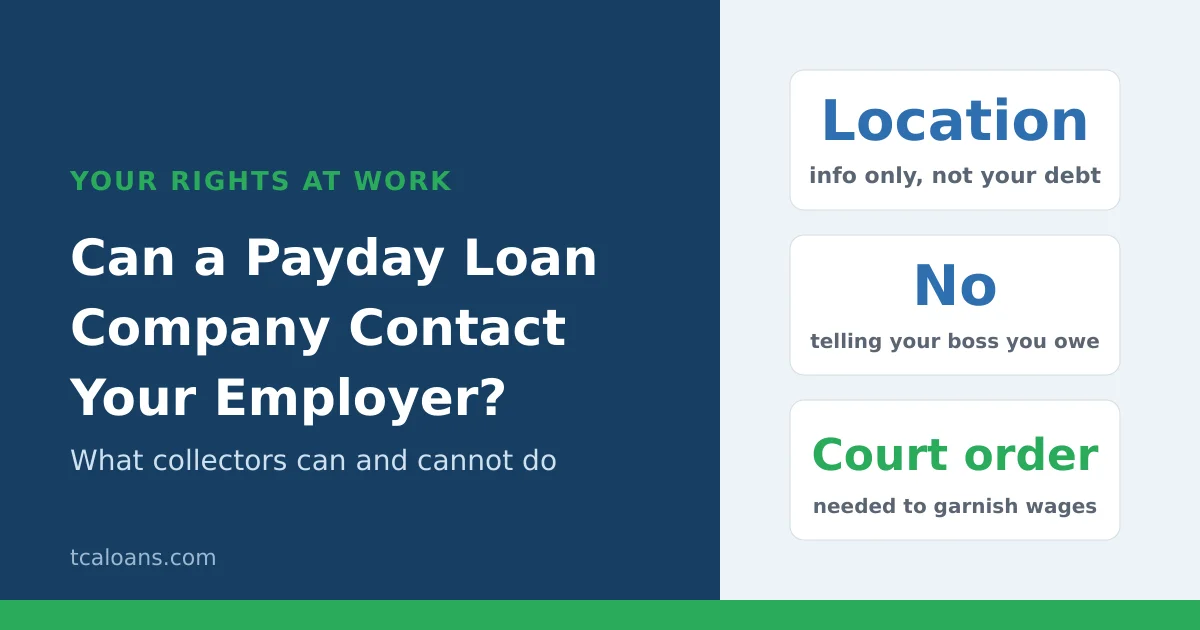
Short answer: A payday lender or debt collector can contact your employer, but only in narrow ways. Under federal law a debt collector may call your workplace to confirm where you work or how to reach you, but it may not tell your employer that you owe a debt (CFPB). Your employer only gets involved in collecting the money if the lender sues you, wins, and gets a court order to garnish your wages (CFPB).
Key points
- Debt collectors may contact other people, including your employer, generally only to find out where you live, your phone number and where you work (CFPB; 15 U.S.C. 1692b).
- When they do, they must not say you owe a debt, and they generally may contact the same person only once (15 U.S.C. 1692b).
- A debt collector must not call you at work if it knows or has reason to know your employer does not allow those calls (15 U.S.C. 1692c(a)(3); 12 CFR 1006.6(b)(3)).
- Wage garnishment requires a court order from a lawsuit. Federal law caps it at 25% of disposable pay, or less for low earners (CFPB; 15 U.S.C. 1673).
- Under the FTC Credit Practices Rule, a lender generally may not take an assignment of your future wages unless you can revoke it, with narrow exceptions such as a payroll deduction plan you set up to make each payment (16 CFR 444.2(a)(3)).
Who the federal rules cover
The federal Fair Debt Collection Practices Act (FDCPA) and the CFPB’s Debt Collection Rule (Regulation F) apply to “debt collectors”: collection agencies, debt buyers and others who regularly collect debts owed to someone else (15 U.S.C. 1692a(6)). A payday lender collecting its own loan in its own name is usually not a “debt collector” under the FDCPA, but if the lender uses a different name that suggests a third party is collecting, the law treats it as one.
Many state laws reach further. Texas, for example, defines a debt collector as any person who “directly or indirectly engages in debt collection,” which includes a lender collecting its own loans (Tex. Fin. Code 392.001(6)). If the lender itself is calling your workplace, check your state’s collection law or ask your state regulator or attorney general.
What a payday lender or collector can do with your employer
| Action | Allowed? | Source |
|---|---|---|
| Call your workplace to confirm you work there or get your home address or phone number | Yes, for location information only. The caller must not say you owe a debt and generally may call that person only once. | 15 U.S.C. 1692b; 12 CFR 1006.10 |
| Tell your boss or coworkers about your debt | No, unless you give the collector consent or a court allows it. | 15 U.S.C. 1692c(b) |
| Call you at work | Yes, unless the collector knows or has reason to know your employer prohibits it. Tell the collector if it does. | 15 U.S.C. 1692c(a)(3); 12 CFR 1006.6(b)(3) |
| Call you before 8 a.m. or after 9 p.m. | No, those times are presumed inconvenient. | 12 CFR 1006.6(b)(1) |
| Send letters to your workplace with collection words on the envelope | No. Location letters must not show that the sender is a debt collector or is about a debt. | 15 U.S.C. 1692b(5) |
| Take money from your paycheck | Only with a court garnishment order after a lawsuit, within federal and state limits. | CFPB; 15 U.S.C. 1673 |
| Threaten garnishment or calling your employer without a court order to scare you into paying | A debt collector may not threaten action it cannot legally take or does not intend to take. The CFPB warns that some payday lenders threaten garnishment without a court order. | 15 U.S.C. 1692e(5); CFPB |
Can a payday lender call my employer to verify my job?
When you apply, many lenders ask for your employer’s name and phone number and for permission to verify your income. If you gave that permission, a call to confirm that you work there is part of the application, not debt collection. Read the application and privacy notice to see what you agreed to. Once your loan is in collection, the federal limits above apply to any debt collector who calls.
Wage garnishment: when your employer actually gets involved
The CFPB says a payday lender “can garnish your wages or bank account only with a court order from a lawsuit filed against you” (CFPB). The steps are:
- The lender or a debt collector sues you for the unpaid loan.
- If it wins, or if you do not respond, the court enters a judgment against you.
- The creditor asks the court for a garnishment order and serves it on your employer.
- Your employer withholds the required part of each paycheck and sends it to the creditor.
Federal law limits a garnishment for an ordinary consumer debt to the lesser of 25% of your disposable earnings for the week, or the amount by which your weekly disposable earnings exceed 30 times the federal minimum hourly wage (15 U.S.C. 1673(a)). With the federal minimum wage at $7.25, that protects the first $217.50 of weekly disposable pay. State law can protect more, and the CFPB notes that “a few states don’t permit it for the collection of payday loan debt” (CFPB). Texas, for example, bans garnishment of current wages except for child support and spousal maintenance; see our Texas payday loan statute of limitations guide.
Federal benefits such as Social Security and SSI that are directly deposited get extra protection: the bank must protect two months’ worth before freezing or garnishing an account (CFPB).
How to stop a collector from calling you at work
- Tell the collector your employer does not allow these calls. Once a collector knows or has reason to know that, it must stop calling you at work. Follow up in writing and keep a copy.
- Ask the collector to stop contacting you. If you write to a debt collector asking it to stop all contact, it must stop, except to tell you it is ending contact or that it or the creditor may take a specific action such as a lawsuit (CFPB; 15 U.S.C. 1692c(c)). The debt is still owed.
- Dispute the debt if it is wrong. Use the validation notice the collector sends, and dispute right away if you do not recognize the amount.
- Report violations. If a collector told your employer about your debt or threatened to, write down the date, the caller and what was said, talk to the person who took the call, and submit a complaint to the CFPB. The CFPB suggests speaking to an attorney if a collector has told your employer you owe a debt (CFPB).
What a payday loan costs
A typical payday loan charges about $15 for every $100 borrowed (CFPB). Representative example: you borrow $300 for 14 days and pay a $45 fee, so you repay $345. That is an APR of about 391%. If you cannot repay on time, a renewal adds a new fee while the $300 is still due. Check your own numbers with our payday loan APR calculator.
Looking for a lower cost loan?
If you are comparing personal loans, which you repay in installments over months, you can start from our personal loans page to be connected with independent lenders. Rates, fees and terms are set by the lender and depend on your credit and state; review the APR disclosure before you accept. Our service is not available in Arkansas, Connecticut, Georgia, Illinois, Massachusetts, Minnesota, New Hampshire, New York, North Dakota, Vermont or West Virginia.
Frequently asked questions
Can a payday loan company call my job?
A debt collector can call your workplace to confirm where you work or how to reach you, and can call you at work unless it knows your employer does not allow it. It may not tell your employer about the debt.
Can a payday lender tell my employer I owe money?
Not under the federal debt collection law, unless you give consent or a court permits it. Some state laws apply the same limits to lenders collecting their own loans.
Can a payday loan company garnish my wages without going to court?
No. The CFPB says a payday lender needs a court order from a lawsuit to garnish your wages or bank account.
How much of my paycheck can be garnished for a payday loan?
Under federal law, no more than 25% of weekly disposable earnings, or the amount above 30 times the federal minimum wage if that is less. Some states allow less or none.
Will my employer find out I took a payday loan?
Usually not, unless you listed your employer and agreed to employment verification, or the lender later gets a garnishment order that is served on your employer.
What should I do if a collector keeps calling me at work?
Tell the collector, then put it in writing, that your employer does not allow these calls. If the calls continue, keep notes and submit a complaint to the CFPB or your state regulator.
Related reading
- Payday loan laws by state (2026)
- Payday loan statute of limitations in Texas
- How much does a payday loan really cost? APR calculator
- Does filing bankruptcy remove payday loan debt?
Sources
- CFPB, Can debt collectors tell other people, like family, friends, or my employer, about my debt?
- CFPB, Can a payday lender garnish my bank account or my wages if I don’t repay the loan?
- CFPB, Can a debt collector take or garnish my wages or benefits?
- CFPB, How do I get a debt collector to stop calling or contacting me?
- CFPB, What is a payday loan?
- 15 U.S.C. 1692a (FDCPA definitions)
- 15 U.S.C. 1692b (acquisition of location information)
- 15 U.S.C. 1692c (communication in connection with debt collection)
- 15 U.S.C. 1673 (restriction on garnishment)
- 15 U.S.C. 1692e (false or misleading representations)
- 12 CFR 1006.6 (Regulation F, communications)
- 12 CFR 1006.10 (Regulation F, location information)
- 16 CFR 444.2 (FTC Credit Practices Rule)
- Texas Finance Code ch. 392 (debt collection)
- CFPB, Submit a complaint
Last reviewed October 26, 2026 by the TCA Financial Editorial Team. Found an error? Email support@tcaloans.com.