Payday Loan vs Earned Wage Access: Costs, Rules and Risks Compared
By TCA Financial Editorial Team. Last reviewed: October 25, 2026.
Disclosure: TCA Financial (tcaloans.com) is not a lender and does not make credit decisions. We connect people with independent lenders and may be paid by those lenders for advertising. We are not paid by any earned wage access provider. This guide is general information, not financial or legal advice.
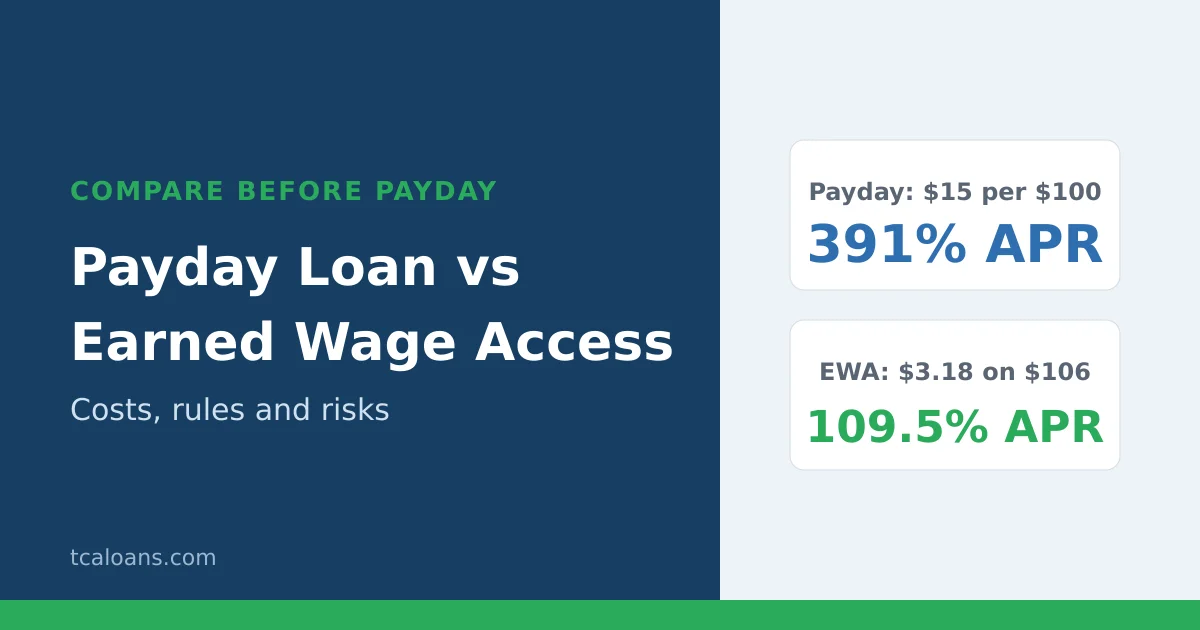
Short answer: Earned wage access (EWA) lets you draw pay you have already earned before payday, usually for a small fee per advance. A payday loan is credit: you borrow money you have not earned yet and repay it, plus a fee, on your next payday. Per transaction, EWA is usually much cheaper. The CFPB found an average fee of $3.18 on an average $106 advance, while a typical payday loan charges $15 per $100 (CFPB). Both get expensive when you use them every pay period, and the rules that protect you are very different.
Key points
- A payday loan is a loan under federal Truth in Lending rules, so the lender must disclose an APR before you sign (12 CFR 1026.18). A $45 fee on $300 for 14 days is about 391% APR.
- Since December 2025, the CFPB treats employer-integrated EWA that meets four conditions (“Covered EWA”) as not credit, so no APR disclosure is required (CFPB advisory opinion, 90 FR 60069).
- EWA fees are small but frequent. In CFPB data, the average worker made 27 advances a year and paid $68.88 in fees (CFPB data spotlight, 2024).
- Direct-to-consumer EWA apps often add subscriptions (up to $14.99 a month in CFPB data) and “tips”, which can push the effective APR near payday levels (CFPB).
- States disagree. Nevada, Missouri, Wisconsin, Kansas, South Carolina, Utah, Indiana, Arkansas and Louisiana regulate EWA outside lending law; Connecticut, Maryland and California treat it as a loan.
What is the difference between a payday loan and earned wage access?
A payday loan is a short, single payment loan, usually $500 or less, due on your next payday, typically in two to four weeks (CFPB). The lender usually takes a post dated check or permission to debit your bank account. You are borrowing against money you have not earned yet, and if you cannot repay, the lender can try to collect.
Earned wage access gives you part of the wages you have already worked for before your regular payday. It comes in two forms, which the CFPB describes this way:
- Employer-integrated EWA: a provider contracts with your employer, checks your hours in the payroll system and is repaid by a deduction from your next paycheck.
- Direct-to-consumer EWA: an app you sign up for yourself, with no employer relationship. It estimates your pay from your bank deposits and is repaid by debiting your bank account on payday.
That difference matters: when repayment comes from payroll, there is no bank debit that can bounce. When an app debits your account, a short balance can still cause an overdraft or returned payment fee from your bank.
Payday loan vs EWA at a glance
| Payday loan | Employer-integrated EWA | Direct-to-consumer EWA app | |
|---|---|---|---|
| What you get | A loan, usually $500 or less | Part of wages already earned | An advance estimated from your deposits |
| Typical cost | $10 to $30 per $100 borrowed | Often a free standard option; average $3.18 when a fee is paid | Subscription, expedite fees and optional tips |
| Example APR | About 391% ($15 per $100, 14 days) | About 109.5% (CFPB example: $3.18 on $106, 10 days) | About 290% (CFPB example: $8 on $144, 7 days) |
| How it is repaid | Check or bank debit on payday | Payroll deduction | Bank account debit on payday |
| Federal APR disclosure | Required | Not required for Covered EWA | Not settled by the CFPB |
| If you cannot repay | Renewal fees, collection, NSF fees | Covered EWA: provider has no claim against you | Depends on the app terms and your state |
| Credit check | Varies by lender | Covered EWA: no individual credit check | Varies; often a review of your bank deposits |
| Effect on credit report | Usually not reported unless sent to collections | Covered EWA: provider agrees not to report | Depends on the app |
Sources: CFPB on payday loans, CFPB paycheck advance data spotlight (July 2024), CFPB EWA advisory opinion (December 2025).
What each one costs: a worked example
Payday loan: you receive $300 and owe $345 in 14 days. The $45 fee equals 391% APR. If you renew twice, you pay $135 in fees over 42 days and still owe the $300. The CFPB found that over 80% of payday loans are rolled over or followed by another loan within 14 days (CFPB Data Point, 2014). Our payday loan cost and APR calculator shows the cost for your state.
Employer-integrated EWA: the CFPB example is a $106 advance with a $3.18 fee for 10 days, which works out to 109.5% APR (CFPB). The same $3.18 fee on a $50 advance taken four days before payday equals about 580% APR. Small advances taken close to payday have the highest APR, even though the dollar fee is low.
Direct-to-consumer EWA app: the CFPB example is a $144 advance with $8 in combined tips and fees for seven days, about 290% APR. California’s regulator found an average APR of 334% for EWA companies that took tips and 331% for those that did not in 2021, counting tips as a cost (California DFPI).
The yearly cost is what to watch
The average worker in the CFPB sample made 27 EWA transactions a year, drew about $3,000 in total and paid $68.88 in fees, and about 90% of workers paid at least one fee. Almost all of the fees (96.6%) were for faster delivery (CFPB data spotlight). For comparison, one $300 payday loan at $15 per $100, renewed every two weeks for about three months (six fees), costs $270 in fees. If you can wait for the free standard transfer, EWA can cost nothing. If you pay to speed up every advance, the fees add up.
The legal rules: federal and state
Federal: the CFPB position since December 2025
The CFPB has changed its view several times. A 2020 advisory opinion said some free, employer-integrated EWA was not credit (85 FR 79404). In July 2024 the CFPB proposed treating most paycheck advance products, including tips and expedite fees, as credit (CFPB proposal). In May 2025 it withdrew its earlier EWA guidance along with dozens of other documents (90 FR 20084).
The current position is the December 23, 2025 advisory opinion (90 FR 60069). It says “Covered EWA” is not credit under Regulation Z and formally withdraws the 2024 proposal. To be Covered EWA, a product must:
- advance no more than the wages you have already earned, based on payroll data;
- be repaid by a deduction from your next paycheck;
- have no legal claim against you, no debt collection and no credit reporting if the deduction falls short; and
- not assess your individual credit risk.
The opinion says expedite fees and tips are normally not finance charges. It also says it does not decide whether other EWA products, such as most direct-to-consumer apps, are credit. A federal bill on EWA, H.R. 9330, was reported out of the House Financial Services Committee in September 2026 but has not become law (Congress.gov).
State EWA laws
Payday loans are governed by each state’s lending laws, which set fees, loan limits and whether payday lending is allowed at all; see our payday loan laws by state guide. EWA is newer, and states take two approaches:
| State | Law | Treats EWA as | Fee limit |
|---|---|---|---|
| Nevada | NRS ch. 604D (2023) | Not a loan; license required; one no-cost option required | None in statute |
| Missouri | RSMo 361.749 (2023, amended 2026) | Not a loan; registration required | None in statute |
| Wisconsin | Wis. Stat. ch. 203; 2025 Act 199 | Licensed outside the Consumer Act; one no-cost option required | $5 up to $75 advanced; $7.50 above $75 (from April 2026) |
| Kansas | HB 2560 (2024) | Not a loan; registration required | No dollar cap; expedite fees must not be unreasonable |
| South Carolina | Act 190 of 2024 | Not a consumer loan | None in statute |
| Utah | HB 279 (2025) | Not a loan; registration and one no-fee option required | None in statute |
| Indiana | IC 28-8-6 (2025, effective 2026) | Separate EWA license, not a small loan license | See the Department of Financial Institutions |
| Arkansas | Act 347 of 2025 | Not lending if the provider follows the act | None in statute |
| Louisiana | Act 496 of 2025 | Not lending if the provider follows the act | None in statute |
| Connecticut | Public Act 25-155 (October 2025) | A small loan (advances under $750) | $4 per advance or $30 per month |
| Maryland | HB 1294, Chapter 847 of 2025 | Covered by the Consumer Loan Law | $5 up to $75; $7.50 above $75; tips banned from October 1, 2026 |
| California | DFPI regulation (February 2025) | A loan under the California Financing Law; registration required | No fee cap in the regulation |
Maryland’s tip ban is in SB 94, Chapter 170 of 2026. In states not listed, there is no EWA specific law; general lending and consumer protection laws may still apply. Laws change often, so check your state regulator’s website before you sign up.
Credit checks and your credit report
Payday lenders usually do not report to the three nationwide credit bureaus, so paying on time does not build your credit. An unpaid payday loan that goes to a debt collector can appear on your report (CFPB). Covered EWA providers must not assess your credit risk and must agree not to report you to a credit bureau or use debt collection if your paycheck deduction falls short (CFPB advisory opinion). Direct-to-consumer apps set their own terms, so read them before you link your bank account.
Risks of each option
Payday loan risks
- Very high APR, commonly around 391% at $15 per $100 for two weeks.
- Renewals and reborrowing add a new fee each time while the original amount stays due.
- Failed bank debits can bring returned payment fees from the lender and NSF fees from your bank.
- In some states payday loans are banned or capped at 36% APR.
Earned wage access risks
- Your next paycheck is smaller by the amount you drew, which can start a cycle of drawing early every pay period. The CFPB average was 27 advances a year.
- Expedite fees, subscriptions and tips are easy to overlook because they are small. The Federal Reserve Bank of Kansas City found transfer fees from $0.49 to $13.99 depending on speed (Kansas City Fed, 2024).
- Fees and tips are often not shown as an APR, so comparing costs is harder. The GAO has noted that EWA costs may not be transparent and that bank debits can cause overdraft fees.
- Not every employer offers EWA, and the amount you can draw is limited to pay you have already earned.
Which one makes sense?
- If your employer offers EWA with a free standard transfer and you can wait a day or two, that is usually the lowest cost way to cover a small gap. Draw only what you need.
- If you would pay a fee for every advance, add up the fees for a month, divide by the amount you drew and compare that with other options.
- If you need more than your earned pay, EWA cannot help. Compare a credit union Payday Alternative Loan, which federal credit unions can offer at up to 28% APR (12 CFR 701.21), a small loan from your bank, or a payment plan with the company you owe.
- A payday loan costs the most per dollar. If you use one, borrow the smallest amount, repay it on the first due date and avoid renewals.
Comparing loan offers through TCA Financial
If you need a loan rather than a wage advance, you can use our loan rate check form to be connected with independent lenders. Rates, fees and terms are set by the lender and depend on your state and situation; review the lender’s APR disclosure before you accept. Our service is not available in Arkansas, New York, Vermont or West Virginia.
Frequently asked questions
Is earned wage access a payday loan?
Not under current federal guidance for employer-integrated products that meet the CFPB’s four conditions. Connecticut, Maryland and California treat EWA as a loan under state law, and the CFPB has not decided the question for most direct-to-consumer apps.
Is EWA cheaper than a payday loan?
Per advance, usually yes. The CFPB average EWA fee was $3.18 on $106, compared with about $15 per $100 for a payday loan. Frequent use with paid fast transfers, subscriptions or tips can narrow the gap.
Does earned wage access affect your credit score?
Covered EWA providers agree not to check your credit or report you to a credit bureau. Direct-to-consumer apps set their own policies, so check the terms.
Do payday loans affect your credit?
Usually not while you pay as agreed, because most payday lenders do not report to the nationwide credit bureaus. If the debt goes to collections, it can be reported and hurt your score.
Are EWA tips required?
No, tips are optional by definition. Maryland bans EWA tips from October 1, 2026, and Connecticut does not allow a voluntary charge such as a tip to default to more than zero.
Can I use EWA and a payday loan at the same time?
You can, but both are repaid from the same paycheck. Taking both can leave too little for rent and bills on payday, which is how reborrowing starts.
Related reading
- How much does a payday loan really cost? APR calculator
- Payday loan laws by state (2026)
- Are payday loans worth the cost?
Sources
- CFPB, What is a payday loan?
- CFPB, Data Point: Payday Lending (March 2014)
- CFPB, Can taking out a payday loan help rebuild my credit?
- CFPB, Data Spotlight: Developments in the Paycheck Advance Market (July 2024)
- CFPB, proposed interpretive rule on paycheck advance products (July 2024, archived)
- Federal Register, CFPB EWA advisory opinion (December 2020)
- Federal Register, CFPB withdrawal of guidance documents (May 2025)
- Federal Register, CFPB advisory opinion on earned wage access (December 2025)
- Congress.gov, H.R. 9330 (119th Congress)
- GAO-23-105536, Financial Technology (March 2023)
- Federal Reserve Bank of Kansas City, As Earned Wage Access Grows (May 2024)
- California DFPI, 2021 Earned Wage Access Data Findings
- California DFPI, Income-based advances
- Connecticut Public Act 25-155
- Maryland HB 1294 (2025)
- Maryland SB 94 (2026)
- Nevada NRS chapter 604D
- Missouri RSMo 361.749
- 2025 Wisconsin Act 199
- Kansas HB 2560 (2024)
- South Carolina S. 700, Act 190 of 2024
- Utah HB 279 (2025)
- Indiana DFI, EWA licensing guidance
- Arkansas HB 1517, Act 347 of 2025
- Louisiana HB 368, Act 496 of 2025
- 12 CFR 701.21 (NCUA Payday Alternative Loans)
- 12 CFR 1026.18 (Regulation Z disclosures)
Last reviewed October 25, 2026 by the TCA Financial Editorial Team. Found an error? Email support@tcaloans.com.