Credit Union PAL Loans: PAL I vs PAL II and How to Apply Online
By the TCA Financial Editorial Team. Last reviewed: October 27, 2026.
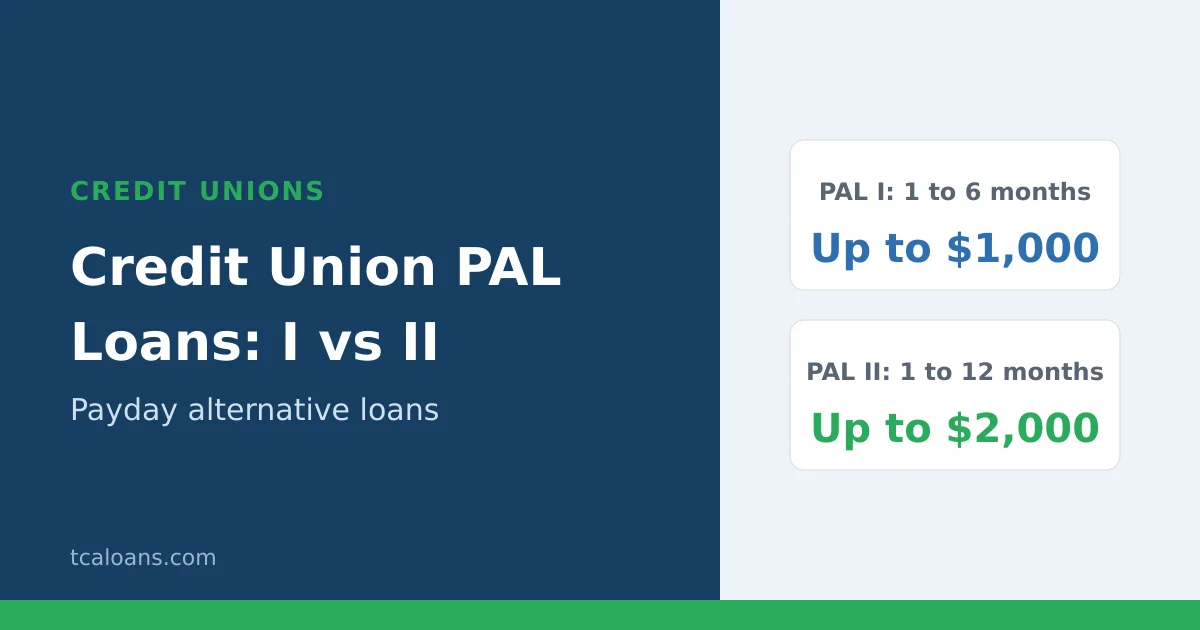
Short answer: Payday alternative loans (PALs) are small loans from federal credit unions with an interest rate of up to 28% (NCUA). PAL I loans are $200 to $1,000 for one to six months and require at least one month of membership. PAL II loans go up to $2,000 for one to twelve months, with no minimum membership period (12 CFR 701.21(c)(7)). Both cap the application fee at $20 and ban rollovers. Many credit unions take applications online, but you have to be, or become, a member.
Key points
- Federal credit unions may charge up to 28% on payday alternative loans, 10 percentage points above the current 18% general ceiling, which the NCUA Board extended through September 10, 2027 (NCUA).
- Both PAL types must be fully amortizing closed-end loans, so each payment pays down principal (12 CFR 701.21(c)(7)).
- A credit union may make no more than three PALs to one borrower in a rolling six months, and only one at a time (12 CFR 701.21(c)(7)).
- The application fee must reflect actual processing cost and can never exceed $20 (12 CFR 701.21(c)(7)).
- For PAL II, the credit union may not charge overdraft or non-sufficient funds fees in connection with the loan (12 CFR 701.21(c)(7)(iv)).
PAL I vs PAL II at a glance
| Feature | PAL I | PAL II |
|---|---|---|
| Loan amount | $200 to $1,000 | Up to $2,000 |
| Term | 1 to 6 months | 1 to 12 months |
| Maximum interest rate | 28% (18% ceiling plus 10 points) | 28% (18% ceiling plus 10 points) |
| Membership before borrowing | At least 1 month | No minimum period in the rule |
| Application fee | Up to $20 | Up to $20 |
| Rollovers | Not allowed | Not allowed |
| Loans per borrower | Max 3 PALs (I or II) in 6 months, 1 at a time | Max 3 PALs (I or II) in 6 months, 1 at a time |
| Overdraft or NSF fees on the loan | Not addressed in PAL I rule | Not allowed |
What a PAL costs compared with a payday loan
Payday loan, representative example: a typical payday loan charges about $15 per $100 (CFPB). Borrow $300 for 14 days with a $45 fee and you repay $345, an APR of about 391%.
PAL I, illustrative example: borrow $500 for six months at 28%. Your payment is about $90.27 a month and you pay about $41.62 in interest in total, plus an application fee of up to $20. That is about $61.62 in total cost for a larger loan over a much longer time. Your credit union’s actual rate may be lower than 28%.
The APR is the best way to compare loan types, and lenders must disclose it before you sign (CFPB). Try both loans in our payday loan cost and APR calculator.
Which one fits you
- PAL I suits a small, short need of up to $1,000 if you have already been a member for a month.
- PAL II suits a larger amount, up to $2,000, a longer payback of up to a year, or a new member who cannot wait a month.
- Not every federal credit union offers PALs, and some offer only one type. State-chartered credit unions follow their own state rules.
How to apply for a PAL online
- Find credit unions you can join with the NCUA’s credit union locator. Membership is often based on where you live, work or worship, or on an employer or group.
- Check the credit union’s website for “payday alternative loan”, “PAL” or “small dollar loan”.
- Join the credit union if you are not already a member; for PAL I, note the one month membership requirement.
- Apply online or in a branch. Expect to show proof of income, such as recent pay stubs; the rule suggests credit unions verify employment this way.
- Compare the APR and payment before you sign, and set up payments you can keep up with.
Credit unions decide whether to approve you. The NCUA says federal credit unions generally may not charge more than 18% on most loans, which is why PALs are a lower cost option where they are available (NCUA). Check your state’s payday rules in payday loan laws by state.
If a PAL is not available
If no credit union near you offers a PAL, a personal loan repaid in installments may cost less than a payday loan. If you want to compare offers, you can start from our personal loans page to be connected with independent lenders; the service is not available in Arkansas, Connecticut, Georgia, Illinois, Massachusetts, Minnesota, New Hampshire, New York, North Dakota, Vermont or West Virginia. Rates, fees and terms are set by the lender and depend on your credit and state, and they may be higher than a PAL. See also payday loan vs installment loan.
Frequently asked questions
What is the difference between PAL I and PAL II?
PAL I is $200 to $1,000 for one to six months and requires one month of membership. PAL II is up to $2,000 for one to twelve months, has no minimum membership period and bans overdraft and NSF fees tied to the loan.
What is the maximum interest rate on a credit union PAL?
28%, which is 10 percentage points above the NCUA’s current 18% ceiling for most federal credit union loans.
Can I get a PAL loan online?
Often, yes, if the credit union offers PALs and lets members apply online. You usually need to be a member first.
How many PAL loans can I have?
One at a time, and no more than three in any rolling six-month period from the same credit union.
Do PAL loans check credit?
Credit unions set their own underwriting. The rule tells them to manage risk, for example by verifying employment with recent pay stubs.
Related reading
- Payday loan laws by state (2026)
- How much does a payday loan really cost? APR calculator
- Payday loan vs installment loan
- How to negotiate payday loan debt
Sources
- 12 CFR 701.21(c)(7)(iii) and (iv), payday alternative loans (PALs I and II)
- NCUA, Permissible loan interest rate ceiling extended
- NCUA, Credit union locator
- CFPB, What is a payday loan?
- CFPB, What is an APR and why is it higher than the interest rate for my payday loan?
Last reviewed October 27, 2026 by the TCA Financial Editorial Team. Found an error? Email [email protected].
Disclosure: TCA Financial (tcaloans.com) is not a lender and does not make credit decisions. We connect people with independent lenders and may be paid by those lenders for advertising. We are not affiliated with the NCUA or any credit union. This guide is general information, not legal, tax or financial advice. A nonprofit credit counselor, legal aid office or tax professional can tell you how it applies to you.