How to Negotiate Payday Loan Debt: Payment Plans, Settlements and Your Rights
By the TCA Financial Editorial Team. Last reviewed: October 26, 2026.
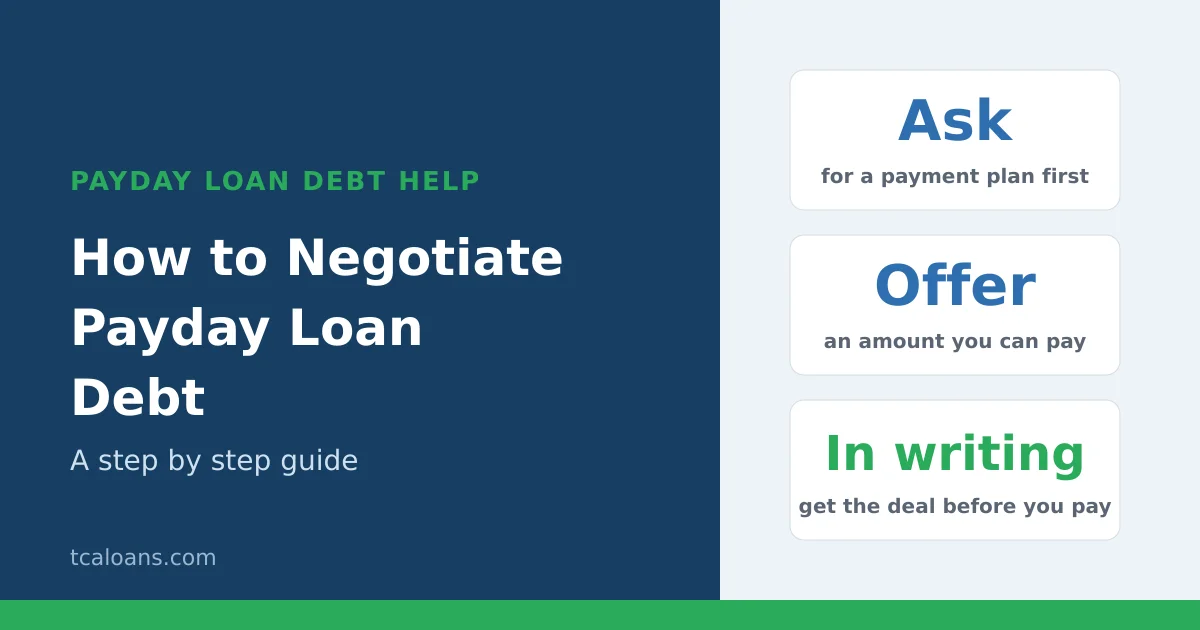
Short answer: To negotiate payday loan debt, first ask the lender for an extended payment plan, which some states require lenders to offer at no extra cost. If the loan is already in collection, confirm you owe it, work out what you can really pay, and offer either a payment plan or a lump sum settlement, then get the deal in writing before you pay (CFPB; CFPB). You can do this yourself for free, and a nonprofit credit counselor can help.
Key points
- Call the lender as soon as you know you cannot pay and ask for an extended repayment plan. Whether you get one depends on your state law or the lender’s policy (CFPB).
- Some states require a free plan: Florida gives a 60 day grace period with credit counseling, Washington lets you convert the loan to an installment plan with no added fee, and Utah requires an extended payment plan with no interest or fees (Fla. Stat. 560.404; RCW 31.45.084; Utah Code 7-23-403).
- You can revoke the lender’s permission to debit your bank account so you control when and how much you pay. You still owe the loan (CFPB).
- For-profit debt relief companies sold by phone may not charge you a fee until they have settled at least one debt and you have made a payment under it (16 CFR 310.4(a)(5)).
- If a lender forgives part of what you owe, the forgiven amount may count as taxable income (IRS Topic 431).
Step 1: Ask the lender for an extended payment plan
The CFPB’s first advice for a payday loan you cannot repay is to “contact your lender right away and ask for an extended repayment plan or if there are other options.” A plan lets you repay in smaller installments over a longer time; depending on state law it may be free or carry a fee (CFPB). Ask before the due date: some state plans must be requested before the loan is due.
| State | What the law gives you | Extra cost | Source |
|---|---|---|---|
| Florida | If you tell the lender by the end of the term that you cannot pay, a 60 day grace period, as long as you make a credit counseling appointment within 7 days and finish it within the 60 days. Installment loans: you can defer one scheduled payment. | None | Fla. Stat. 560.404(22), (23) |
| Washington | If you tell the lender you cannot repay, it must convert the loan to an installment plan on request: at least 90 days for loans up to $400, at least 180 days above $400. Postdated checks for the original loan are returned. | No fee for converting; a one-time $25 fee only if you default on the plan | RCW 31.45.084 |
| Utah | On request, an extended payment plan at least once every 12 months, in at least four equal payments over at least 60 days (or 90 days after default, if longer). Also available after 10 weeks of fees and rollovers. | No interest or fees of any kind | Utah Code 7-23-403 |
Other states have their own rules, and many lenders offer plans by policy even where the law does not require one. Our payday loan laws by state table links to each state’s law and regulator.
Step 2: Protect your bank account
Payday lenders usually have your permission to take payments straight from your account. If repeated debits are causing overdraft or returned payment fees, you can take back that permission. The CFPB says to call and write the lender to revoke the authorization, tell your bank you have revoked it, and, to stop the next payment, give your bank a stop payment order at least three business days before it is scheduled (CFPB). Banks often charge for stop payment orders.
Revoking does not cancel the loan; you still owe it. Use the time to set up a plan you can keep, not to stop paying altogether.
Step 3: Confirm what you owe
If a debt collector has the loan, it must give you validation information, generally within five days of first contacting you, showing the amount, the creditor and how to dispute (CFPB; 12 CFR 1006.34). Check it against your loan papers. If the amount includes fees you do not recognize, or the debt is not yours, dispute it in writing before you negotiate.
Step 4: Work out what you can pay
The CFPB suggests writing down your monthly take-home pay and expenses and leaving room for emergencies, because “falling behind on other bills, even if you’re paying off this debt, could cause you more problems” (CFPB). Decide two numbers before you call:
- the monthly payment you can keep up for the whole plan, and
- the most you could pay as a one-time lump sum to settle the debt.
Step 5: Make your offer
Call or write to the lender or collector and make a specific offer. A simple script:
“I took out a loan on [date] and I cannot repay the full balance of $[amount]. I can pay $[amount] every [two weeks or month] starting [date], with no new fees. Can you put that plan in writing?”
Or, for a settlement: “I can pay $[amount] in one payment by [date] to settle this debt in full. If you agree, please send written confirmation that this payment will resolve the account and that the balance will be reported as settled.”
Start lower than your maximum and leave room to move. Keep notes of every call: date, name and what was agreed.
Step 6: Get it in writing, then pay
Before you send money, get a letter or email that states the amount, the payment dates, that no new fees will be added, and, for a settlement, that the payment resolves the debt in full. Pay in a way you can trace, and do not give the collector new open access to your bank account unless you are comfortable with it. Keep the agreement and your proof of payment.
Settlement vs payment plan
| Extended payment plan | Lump sum settlement | |
|---|---|---|
| Best when | You can pay the full balance over time | You can raise a lump sum and the account is already in collection |
| What you pay | Usually the full balance; state plans may forbid new fees | Less than the balance, if the creditor agrees |
| Credit report | Depends on how the account is reported | Often shown as settled for less than the full amount |
| Taxes | Usually no tax effect | The forgiven part may be taxable income; you may get a Form 1099-C |
On taxes, the IRS says that if a debt is “canceled, forgiven, or discharged for less than the amount owed, the amount of the canceled debt is taxable,” with several exceptions, and that the creditor may send you a Form 1099-C (IRS Topic 431).
Should you use a debt settlement company?
Be careful. The CFPB warns that debt settlement companies “often charge expensive fees,” typically tell you to stop paying your bills, and that “debt settlement may well leave you deeper in debt than you were when you started” (CFPB). Under the FTC’s Telemarketing Sales Rule, a debt relief company that sells its services by phone may not take a fee until it has settled or changed at least one of your debts and you have made at least one payment under that agreement (16 CFR 310.4(a)(5)). A company that asks for money up front is a red flag.
A nonprofit credit counselor is usually a better first call. Credit counselors help you budget and can set up a debt management plan with one monthly payment to the agency, and they “never” advise you to stop paying your debts (CFPB). In Florida, completing credit counseling is also what unlocks the 60 day grace period.
If you are sued
Do not ignore a court summons. You can still negotiate after a lawsuit is filed, but you must also respond to the court by the deadline or the creditor can get a default judgment (CFPB). The CFPB notes that responding does not mean you agree you owe the debt, and that if you do owe it, “you may be able to work out a settlement or other resolution with the collector.” A legal aid office can help for free if you qualify.
What a payday loan costs while you wait
A typical payday loan charges about $15 per $100 borrowed (CFPB). Representative example: you borrow $300 for 14 days and pay a $45 fee, so you repay $345, an APR of about 391%. Rolling the loan over instead of setting up a plan adds another $45 every two weeks while the $300 is still owed: four rollovers cost $180 in fees and you still owe the $300. See the numbers for your loan in our payday loan APR calculator.
Refinancing with a lower cost loan
Some borrowers replace payday debt with a lower APR personal loan repaid in installments. If you want to compare offers, you can start from our personal loans page to be connected with independent lenders. Rates, fees and terms are set by the lender and depend on your credit and state; only refinance if the new APR and total cost are lower, and review the disclosure before you accept. Our service is not available in Arkansas, Connecticut, Georgia, Illinois, Massachusetts, Minnesota, New Hampshire, New York, North Dakota, Vermont or West Virginia.
Frequently asked questions
Can you negotiate a payday loan?
Yes. Ask the lender for an extended payment plan first; some states require one. If the loan is in collection, you can offer a payment plan or a lump sum settlement and should get any agreement in writing before paying.
Will a payday lender settle for less?
Some will, especially after the loan has gone to collection, but they are not required to. Offer an amount you can pay at once and ask for written confirmation that it settles the debt in full.
Does negotiating a payday loan hurt your credit?
Payday lenders often do not report on-time payments, but a debt in collection can be reported. A settled account may be reported as settled for less than the full balance.
Is it better to settle or set up a payment plan?
A payment plan avoids settlement tax issues and is often free under state law. A settlement can cost less if you can raise a lump sum and the creditor agrees.
Can I stop a payday lender from taking money from my account?
Yes. Revoke the payment authorization with the lender and your bank, and use a stop payment order for the next debit. You still owe the loan.
Should I pay a company to negotiate my payday loans?
Be careful. Telemarketed debt relief companies may not charge until they settle a debt, and a nonprofit credit counselor can help for little or no cost.
Related reading
- Payday loan laws by state (2026)
- How much does a payday loan really cost? APR calculator
- Can a payday loan company contact your employer?
- Does filing bankruptcy remove payday loan debt?
Sources
- CFPB, How do I negotiate a settlement with a debt collector?
- CFPB, What can I do if I can’t repay my payday loan?
- CFPB, How can I stop a payday lender from electronically taking money out of my account?
- CFPB, What is a debt relief program?
- CFPB, Credit counseling vs debt settlement, consolidation or credit repair
- CFPB, What should I do if I’m sued by a debt collector or creditor?
- CFPB, What is a payday loan?
- 12 CFR 1006.34 (validation information)
- 16 CFR 310.4 (FTC Telemarketing Sales Rule)
- IRS Topic 431, Canceled debt
- Fla. Stat. 560.404
- RCW 31.45.084 (Washington installment plan)
- Utah Code 7-23-403 (extended payment plan)
- CFPB, Submit a complaint
Last reviewed October 26, 2026 by the TCA Financial Editorial Team. Found an error? Email support@tcaloans.com.
Disclosure: TCA Financial (tcaloans.com) is not a lender, debt settlement company or credit counselor, and does not make credit decisions. We connect people with independent lenders and may be paid by those lenders for advertising. This guide is general information, not legal, tax or financial advice. A nonprofit credit counselor, legal aid office or tax professional can tell you how it applies to you.