How to Build an Emergency Fund on a Low Income: Steps That Work
By the TCA Financial Editorial Team. Last reviewed: October 30, 2026.
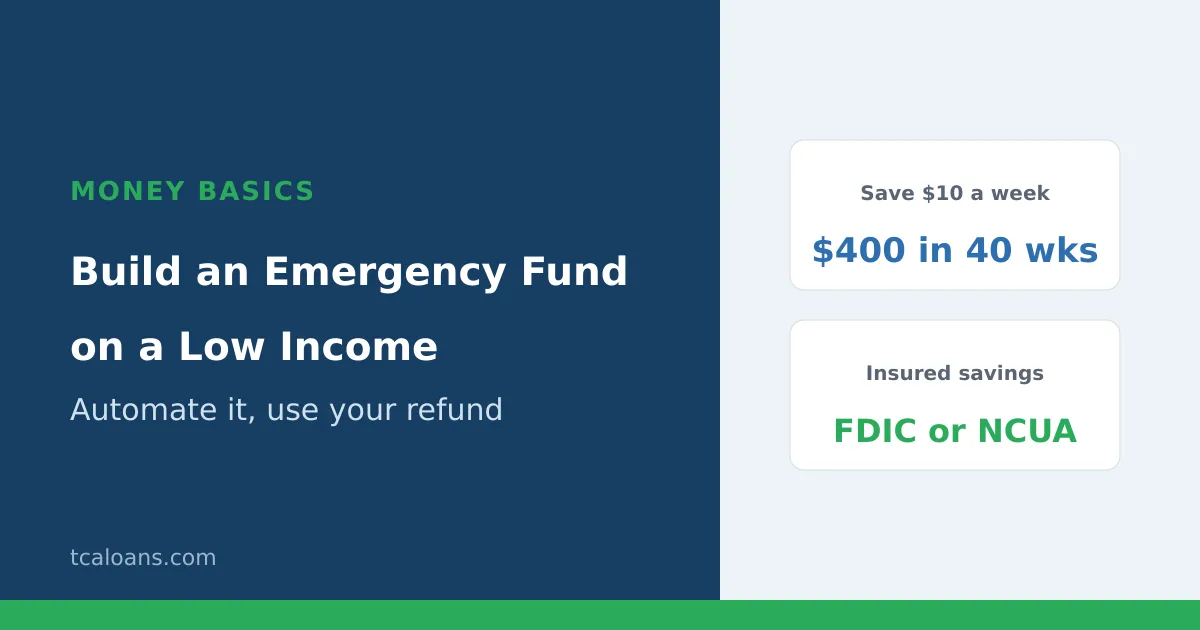
Short answer: To build an emergency fund on a low income, pick a small first goal, such as the cost of your last surprise bill, and save toward it automatically: a recurring transfer from checking to savings, part of each paycheck sent by direct deposit, or part of your tax refund. Keep the money in a separate account at a federally insured bank or credit union, and use it only for real emergencies. The CFPB says that “even a small amount can provide some financial security” (CFPB), and $10 a week reaches $400 in 40 weeks.
Key points
- An emergency fund is “a cash reserve that’s specifically set aside for unplanned expenses or financial emergencies,” such as car repairs, medical bills or a loss of income (CFPB).
- In 2025, 63% of U.S. adults said they would cover a $400 emergency expense with cash or its equivalent. Among adults with income under $50,000, 4 in 10 said they could not cover even a $100 emergency expense with their savings alone (Federal Reserve).
- The CFPB calls automatic recurring transfers “one of the easiest ways” to save consistently, and says putting away part of a tax refund is one of the easiest ways to start on a tight budget (CFPB).
- You can split a federal tax refund across up to three accounts in your name, at least $1 each (IRS).
- Deposits at an FDIC-insured bank are insured up to $250,000 per depositor, per bank, per ownership category (FDIC). Nonbank apps “are never FDIC-insured” themselves (FDIC).
- Without savings, a small shock can turn into debt. A two week payday loan fee of $15 per $100 works out to an APR of “almost 400 percent” (CFPB).
Why an emergency fund matters
Most money trouble starts with one bill nobody planned for: a car repair, an ER copay, a week of lost shifts. The CFPB warns that without savings, even a minor financial shock “could set you back, and if it turns into debt, it can potentially have a lasting impact.” People without savings “may rely on credit cards or loans, which can lead to debt that’s generally harder to pay off” (CFPB).
The Federal Reserve’s 2025 survey of household finances shows how common that gap is. Sixty three percent of adults said they would pay a hypothetical $400 emergency expense “exclusively using cash, savings, or a credit card paid off at the next statement,” a share unchanged from the previous three years and down from 68% in 2021. Among adults earning less than $50,000, 4 in 10 could not cover even $100 from savings alone (Federal Reserve).
That gap is what short-term lenders fill. Representative example: a $300 payday loan for 14 days with a $45 fee is an APR of about 391%, and the CFPB notes that a two week fee of $15 per $100 equals an APR of “almost 400 percent” (CFPB; CFPB). Every dollar in an emergency fund is a dollar you do not have to borrow at that price. You can test any loan offer in our payday loan cost and APR calculator.
How much should you save?
There is no single right number. The CFPB says “the amount you need to have in an emergency savings fund depends on your situation,” and suggests you “think about the most common kind of unexpected expenses you’ve had in the past and how much they cost” (CFPB). For many people that means a first goal of a few hundred dollars, then one month of essential bills, then more.
Small, regular amounts add up faster than most people expect. Our own calculation, before any interest:
| You save | Weeks to reach $400 | Weeks to reach $1,000 | Saved after one year (52 weeks) |
|---|---|---|---|
| $5 a week | 80 | 200 | $260 |
| $10 a week | 40 | 100 | $520 |
| $20 a week | 20 | 50 | $1,040 |
| $25 a week | 16 | 40 | $1,300 |
If you are paid every two weeks, $20 per paycheck is the same as $10 a week. If $5 is all you can spare, start there. The habit matters more than the amount at first, and you can raise it when a bill is paid off or your pay goes up.
Step 1: Find room in your cash flow
Saving on a low income usually starts with timing, not cutting. The CFPB describes cash flow as “the timing of when your money is coming in (your income) and going out (your expenses and spending).” When bills cluster in one week, you run short even if the month adds up. The CFPB suggests you “work with your creditors (like your landlord, utility companies, or credit card companies) to adjust the due dates for your bills,” then move a little extra into savings in the weeks when you have more (CFPB).
Write down every bill, its amount and its due date next to your paydays. Our guides to budgeting on a low income and the envelope budget system walk through simple ways to do it, and how to save more money covers ways to lower the bills themselves.
Step 2: Make saving automatic
Automation does the work that willpower cannot. The CFPB calls it “one of the easiest ways to make your savings consistent,” and gives two main ways to do it (CFPB):
- A recurring transfer. Set your bank or credit union to move a fixed amount from checking to savings on payday. You choose “how much and how often” (CFPB).
- Split direct deposit. Ask your employer whether your paycheck can be divided between two accounts, so part of it goes to savings before you see it. The CFPB calls this “pay yourself first” (CFPB).
Two cautions. First, the CFPB reminds you to “be mindful of your balances” so a transfer does not trigger an overdraft fee, and suggests balance alerts or calendar reminders (CFPB). Set the transfer for the day after payday, not the day before. Second, automate your bills only when you know the money will be there. Autopay for a fixed bill, such as rent or a phone plan, helps you avoid late fees, but an automatic debit that hits an empty account can cost you a fee from the bank. See payday loans vs overdrafts for how those fees compare.
Step 3: Use your tax refund to jump start it
For many households the tax refund is the biggest check of the year. The CFPB notes that “for many Americans, a tax refund can be one of the largest checks they receive all year,” and says that if you have a limited ability to save, putting away part of your refund is one of “the easiest ways to get started” (CFPB).
You can send part of the refund straight to savings when you file. The IRS lets you split a refund “in any proportion you want” into up to three accounts at U.S. financial institutions; the accounts must be in your name and each deposit must be at least $1 (IRS). Tax software handles it when you e-file, and on a paper return you attach Form 8888 (IRS).
A simple plan for a refund, in order:
- Put a set share, such as the first $400 or $500, into your emergency savings account.
- Pay any past due bill that is costing you late fees, or a high cost loan.
- Pay down high interest credit card debt.
- Then spend part of what is left on something you have been putting off. A plan you can keep beats one you will abandon.
Watch the costs of getting the refund. About 100 million people are estimated to be eligible to file for free, and the CFPB suggests checking free options first (CFPB). The IRS Free File program is one of them. Some paid preparers offer a refund anticipation check, which lets you pay the prep fee out of the refund, but “a RAC doesn’t deliver your refund more quickly” and the fee “typically” runs $30 to $50 (CFPB). A refund advance loan lends you part of the refund early. Some are free and some charge fees and interest, and since “the IRS typically issues most refunds in less than 21 days” when you e-file, “you could end up paying a big RAL fee for a short-term advance” (CFPB). With direct deposit, the IRS issues “more than nine out of ten refunds in less than 21 days” (IRS).
Step 4: Keep it safe, separate and easy to reach
The CFPB says your emergency fund should be “safe, accessible, and in a place where you’re not tempted to spend it on non-emergencies,” and calls a bank or credit union account “generally considered one of the safest places to put your money” (CFPB). A separate savings account, even at the same bank as your checking, keeps it out of sight.
| Where | Protection | Watch for | Source |
|---|---|---|---|
| Savings account at an FDIC-insured bank (branch or online) | Insured up to $250,000 per depositor, per bank, per ownership category | Monthly fees and minimum balances; check the bank on FDIC BankFind | FDIC |
| Savings (share) account at a federally insured credit union | Insured by the NCUA Share Insurance Fund up to $250,000 for individual accounts | You must be a member | NCUA |
| Balance held in a payment or fintech app | The app company itself is never FDIC-insured; pass-through coverage is possible only if your money is placed in an insured bank and other conditions are met | Deposit insurance “does not protect against the insolvency or bankruptcy of a nonbank company” | FDIC |
| Prepaid card | Depends on the card program | You can spend only what is loaded; read the fee schedule | CFPB |
| Cash at home | None | “Cash can be stolen, lost, or destroyed” | CFPB |
Online banks and apps. Online banking makes saving easier: you can open a separate savings account, set transfers and get balance alerts from your phone, and some online banks pay a higher rate. Before you move your emergency fund, check two things. Is it a bank or credit union, or an app company that works with one? You can look up a bank on FDIC BankFind and a credit union on the NCUA locator. And if it is an app, read its disclosures: the FDIC says “nonbank companies themselves are never FDIC-insured,” and your money is not eligible for coverage “until the company deposits them in an FDIC-insured bank and after other conditions are met” (FDIC).
Step 5: Use it, then rebuild it
Decide in advance what counts as an emergency, such as a car repair you need to get to work, a medical bill insurance did not cover, or a gap in pay, and stick to it. When one happens, use the fund. The CFPB says “don’t be afraid to use it if you need it,” and if you spend it down, “just work to build it up again” (CFPB). Restart the same automatic transfer the next payday.
If an emergency hits before your fund is ready
Start with the options that do not add expensive debt. Call the company you owe and ask for a payment plan or a later due date. Ask your employer whether it offers a pay advance; our guide to payday loans vs earned wage access compares the costs. A federal credit union payday alternative loan (PAL II) can be up to $2,000 for one to twelve months, with an application fee of no more than $20 (12 CFR 701.21(c)(7)(iv)). For more ideas, see how to raise cash for emergencies. If you do borrow, compare the APR and the total you will repay, and once the emergency is past, start saving again so the next one costs less.
Frequently asked questions
How much should be in an emergency fund?
It depends on your situation. The CFPB suggests basing the goal on the unexpected expenses you have actually had. A common path is a first goal of a few hundred dollars, then one month of essential bills, then more.
How can I build an emergency fund with no money?
Start with a very small automatic transfer, even $5 a week, and add one-time money such as part of a tax refund or a cash gift. Moving bill due dates to match your paydays can free up room to save.
How long does it take to save $1,000?
At $10 a week it takes 100 weeks; at $20 a week, 50 weeks; at $25 a week, 40 weeks. Adding part of a tax refund can cut that time a lot.
Where should I keep my emergency fund?
A separate savings account at a federally insured bank or credit union is a common choice. Deposits are insured up to $250,000 per depositor, per bank, per ownership category at FDIC-insured banks, and individual accounts at federally insured credit unions are insured up to $250,000 by the NCUA.
Is money in a cash app FDIC-insured?
The app company itself is never FDIC-insured. Your money may get pass-through coverage only if the company places it in an FDIC-insured bank and other conditions are met, so read the app’s disclosures.
Should I use my tax refund to pay debt or save?
Many people do both: put a set amount, such as $400 or $500, into emergency savings first, then use the rest on past due bills and high interest debt. Without savings, the next surprise bill may go back on a card or loan.
Related reading
- Budgeting on a low income: how to make it work
- How to raise cash for emergencies
- How to save more money
- Payday loan vs earned wage access
- How much does a payday loan really cost? APR calculator
Sources
- CFPB, An essential guide to building an emergency fund
- CFPB, Guide to filing your taxes in 2026
- Federal Reserve, Economic Well-Being of U.S. Households in 2025, executive summary
- IRS, Get your refund faster: direct deposit to one, two or three accounts
- IRS, Frequently asked questions about splitting federal income tax refunds
- IRS, About Form 8888, Allocation of Refund
- IRS Free File
- FDIC, Understanding deposit insurance
- FDIC, Banking with third-party apps
- FDIC BankFind
- NCUA, Share insurance coverage
- NCUA credit union locator
- 12 CFR 701.21 (payday alternative loans)
- CFPB, What is a payday loan?
- CFPB, What is an APR and why is it higher than the interest rate for my payday loan?
- CFPB, Submit a complaint
Last reviewed October 30, 2026 by the TCA Financial Editorial Team. Found an error? Email support@tcaloans.com.
Disclosure: TCA Financial (tcaloans.com) is not a bank, credit union, lender or tax preparer, and does not make credit decisions. We connect people with independent lenders and may be paid by those lenders for advertising. This guide is general information, not legal, tax or financial advice. A nonprofit credit counselor or a free tax help site can tell you how it applies to you.