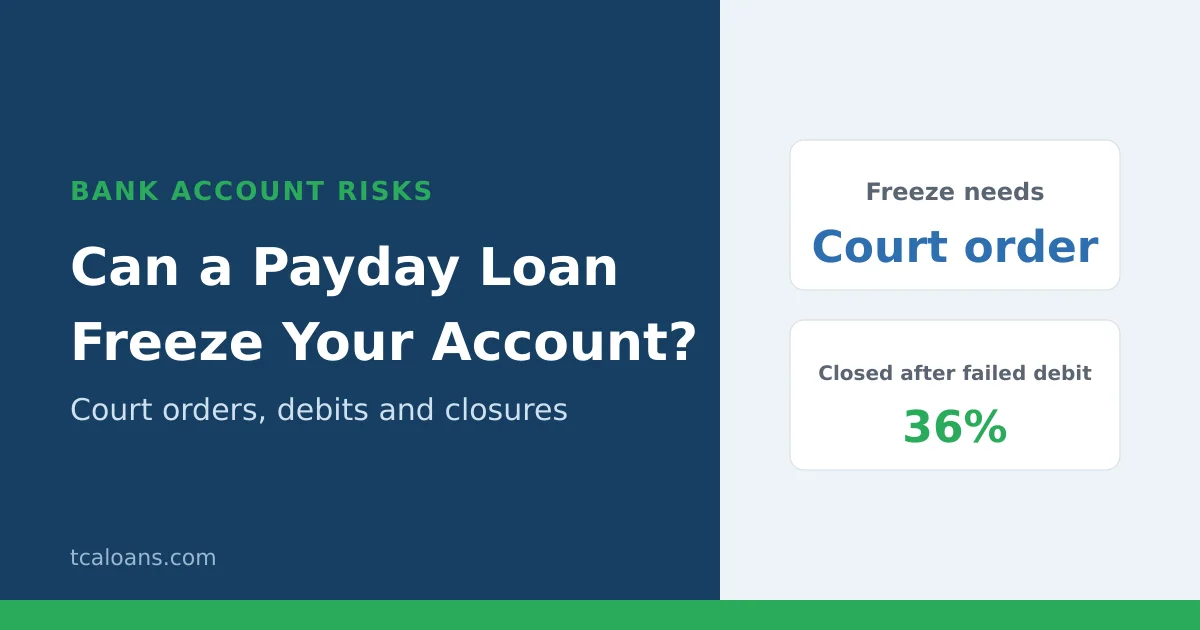
Can a Payday Loan Freeze Your Bank Account? Court Orders, Debits and Your Rights
By the TCA Financial Editorial Team. Last reviewed: October 26, 2026.
Short answer: A payday lender cannot freeze your bank account on its own. To freeze or take money from your account it must sue you, win a judgment and get a court order that your bank then follows (CFPB). Even then, two months of federal benefits that were direct deposited into the account are protected (31 CFR 212.6). What a lender can do without a court is debit your account if you authorized it, and repeated failed debits can lead your bank to close the account.
Key points
- A payday lender can garnish your bank account only with a court order from a lawsuit filed against you (CFPB).
- The federal benefit rule covers garnishment orders, including orders to freeze the assets in an account (31 CFR 212.3), and requires your bank to protect two months of direct deposited federal benefits (31 CFR 212.6).
- A debt collector may not threaten garnishment or seizure unless it is lawful and it actually intends to do it (15 U.S.C. 1692e(4)).
- In a CFPB study, 36% of accounts with a failed debit from an online lender were closed by the bank, usually within 90 days (CFPB).
- You can revoke a lender’s permission to debit your account, but you still owe the loan (CFPB).
When a payday lender can freeze your account
If you do not repay, the lender or a debt collector can generally sue you. If it wins, or if you do not respond to the lawsuit, the court enters a judgment for the amount owed. The lender can then ask for a garnishment order, and your bank must hold back money from your account as your state law allows (CFPB). That hold is what most people experience as a “frozen” account. Each state has its own procedures and exemptions from bank garnishment.
| What happens | Needs a court order? | What you can do |
|---|---|---|
| Lender debits your account on the due date | No, if you authorized it when you signed | Revoke the authorization with the lender and your bank; stop payment on the next debit (CFPB) |
| Debit fails, lender tries again | No | Watch for repeated attempts and bank fees (CFPB) |
| Bank closes your account after failed debits | No; it is your bank’s decision | Talk to your bank early; move direct deposits if needed |
| Lender sues you | Court case starts | Respond by the deadline; do not ignore the summons (CFPB) |
| Bank freezes or takes funds after a judgment | Yes, a garnishment order | Claim your exemptions; two months of direct deposited federal benefits are protected (31 CFR 212.6) |
Money that is protected
When your bank gets a garnishment order, it must look back two months, add up the federal benefits direct deposited in that time, such as Social Security, SSI, VA benefits and federal retirement, and let you use that amount (31 CFR 212.6; CFPB). The CFPB’s example: with $1,000 in monthly Social Security direct deposited, the bank must let you use up to $2,000. Benefits deposited by paper check are not protected automatically, so you may need to claim the exemption with the court (CFPB). Many states also protect part of your wages or a set dollar amount in your account; a legal aid office can tell you what applies where you live. Our guide on payday loans and SSI or disability covers benefit protection in more detail.
The more common risk: failed debits and account closure
Most payday borrowers never see a court order. The bigger risk is the lender’s automatic debits. The CFPB studied online payday and payday installment loans and found that half of borrowers paid an average of $185 in bank penalty fees, and that 36% of accounts with a failed debit attempt were closed by the bank, usually within 90 days of the first non-sufficient funds transaction (CFPB). A closed account can be harder to replace than a frozen one.
If you know a payment will bounce, call the lender before the due date and ask for an extended payment plan (CFPB). The CFPB says you can revoke the debit authorization by contacting the lender and your bank, and give your bank a stop payment order for the next debit (CFPB). Revoking does not cancel the debt. Our guide to negotiating payday loan debt walks through a plan.
Threats to freeze your account
Under the Fair Debt Collection Practices Act, a debt collector may not say or imply that nonpayment will lead to garnishment or seizure of your property unless that action is lawful and the collector or creditor intends to take it (15 U.S.C. 1692e(4)). A caller who says your account “will be frozen today” without any lawsuit is describing something that cannot happen that way. Ask for the name of the court and the case number, and if you think the debt or the caller is not real, you can submit a complaint to the CFPB. Our article on whether a payday loan company can contact your employer covers other collection limits.
What a payday loan costs if it rolls over
A typical payday loan charges about $15 per $100 borrowed (CFPB). Representative example: you borrow $300 for 14 days and pay a $45 fee, so you repay $345, an APR of about 391%. If you cannot pay and roll it over four times, you pay $180 in fees and still owe the $300. Add a returned payment fee from your bank each time a debit fails and the total climbs further. Run your own numbers in our payday loan cost and APR calculator, and see your state’s rules in payday loan laws by state.
Refinancing with a lower cost loan
Some borrowers replace payday debt with a lower APR personal loan repaid in installments. If you want to compare offers, you can start from our personal loans page to be connected with independent lenders; the service is not available in Arkansas, Connecticut, Georgia, Illinois, Massachusetts, Minnesota, New Hampshire, New York, North Dakota, Vermont or West Virginia. Rates, fees and terms are set by the lender and depend on your credit and state; only refinance if the new APR and total cost are lower.
Frequently asked questions
Can a payday lender freeze my bank account without going to court?
No. A payday lender needs a court judgment and a garnishment order before your bank will freeze or take funds. Without a court, it can only collect payments you authorized.
How long after a payday loan default can my account be frozen?
Only after the lender sues, wins a judgment and gets a garnishment order. How long that takes depends on the lender and your state’s court process.
Can a payday lender take my Social Security from my bank account?
Not through garnishment of the protected amount: your bank must protect two months of direct deposited federal benefits. But if you authorized debits, the lender can collect those payments until you revoke the authorization.
Will my bank close my account because of a payday loan?
It can happen. In a CFPB study, 36% of accounts with a failed debit from an online lender were closed by the bank, usually within 90 days.
What should I do if I get a court summons?
Respond by the deadline. If you do not, the lender can get a default judgment and then a garnishment order. Legal aid can help you raise defenses and exemptions.
Related reading
- Payday loan laws by state (2026)
- How much does a payday loan really cost? APR calculator
- How to negotiate payday loan debt
- Can I get a payday loan with SSI or disability benefits?
Sources
- CFPB, Can a payday lender garnish my bank account or my wages?
- 31 CFR 212.3, definitions (garnishment order)
- 31 CFR 212.6, protected amount
- CFPB, Can a debt collector take my Social Security or VA benefits?
- CFPB, How can I stop a payday lender from electronically taking money out of my account?
- CFPB, What can I do if I can’t repay my payday loan?
- CFPB, What should I do if I’m sued by a debt collector or creditor?
- CFPB, Half of online payday borrowers rack up an average of $185 in bank penalties (2016)
- 15 U.S.C. 1692e, false or misleading representations
- CFPB, What is a payday loan?
- CFPB, Submit a complaint
Last reviewed October 26, 2026 by the TCA Financial Editorial Team. Found an error? Email [email protected].
Disclosure: TCA Financial (tcaloans.com) is not a lender and does not make credit decisions. We connect people with independent lenders and may be paid by those lenders for advertising. This guide is general information, not legal, tax or financial advice. A nonprofit credit counselor, legal aid office or tax professional can tell you how it applies to you.