Difference Between a Payday Loan and an Installment Loan
By the TCA Financial Editorial Team. Last reviewed: October 26, 2026.
Short answer: The difference between a payday loan and an installment loan is how you repay it. A payday loan is usually $500 or less and is due in one payment on your next payday (CFPB). An installment loan gives you the money up front and you repay it in fixed payments over months or years (CFPB). Compare the APR and the total you will repay, not just the payment size.
Key points
- Payday loans are short term, high cost loans, generally $500 or less, typically due on your next payday (CFPB).
- Personal installment loans are closed-end loans repaid in set amounts, from a few months to several years, in sizes from several hundred to several thousand dollars or more (CFPB).
- The APR lets you compare costs across loan types, and lenders must disclose it before you agree (CFPB).
- Installment loans can carry fees such as origination or documentation fees and optional insurance (CFPB).
- Some lenders sell “payday installment” loans with high APRs and automatic debits; the CFPB found high bank penalty fees among these borrowers (CFPB).
Payday loan vs installment loan at a glance
| Feature | Payday loan | Personal installment loan |
|---|---|---|
| Typical amount | $500 or less (CFPB) | Several hundred to several thousand dollars or more (CFPB) |
| Repayment | One payment, usually on your next payday | Fixed payments, usually monthly |
| Term | Typically 2 to 4 weeks (CFPB) | A few months to several years (CFPB) |
| Typical cost | About $15 per $100 borrowed, an APR near 400% | Depends on credit, income, debts and state rate limits (CFPB) |
| What the lender checks | Usually income and a bank account | Credit score and reports, income, debts and other factors (CFPB) |
| Common fees | Finance fee; rollover and returned payment fees | Origination, documentation, late fees; optional insurance (CFPB) |
| Payment method | Often a post-dated check or automatic debit | Automatic debit or manual payment |
What each one costs in dollars
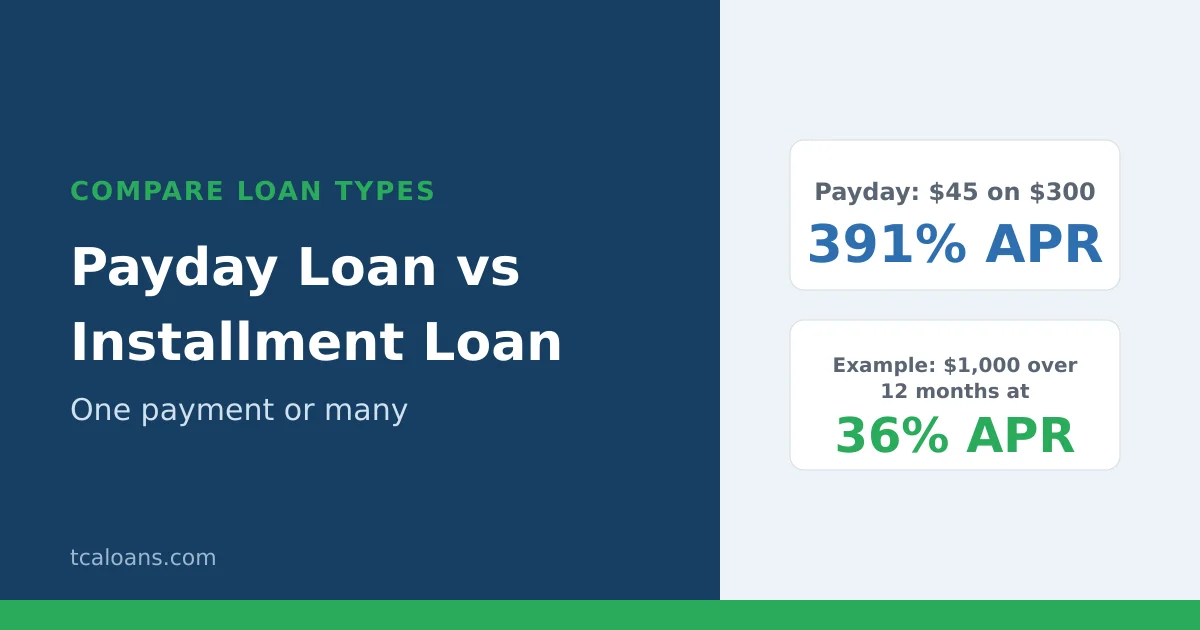
Payday loan, representative example: you borrow $300 for 14 days and pay a $45 fee, the typical $15 per $100 (CFPB). You repay $345, an APR of about 391%. If you cannot repay and roll the loan over four times, you pay $180 in fees and still owe the $300.
Installment loan, illustrative example: you borrow $1,000 for 12 months at a 36% APR with no fees. Your payment is about $100.46 a month and you pay about $205.55 in interest in total. A lower APR lowers that cost; an origination fee raises it. These numbers are an illustration only; your rate and terms depend on the lender, your credit and your state.
A lower monthly payment is not always cheaper. A high-APR installment loan stretched over many months can cost more in total than a single payday fee, so compare the APR and the total of payments on the disclosure (CFPB). Try your own numbers in our payday loan cost and APR calculator.
Rules that apply
State law sets most limits on payday and installment loans, including fee caps, maximum amounts and whether payday lending is allowed at all. See our payday loan laws by state for your state’s rules and regulator. Active duty servicemembers and their dependents are covered by the Military Lending Act, which limits most consumer loans to a maximum of 36% interest (CFPB).
Which one to consider
- If you need a small amount and can repay all of it on your next payday without borrowing again, a payday loan is short but expensive. Check whether your state allows it first.
- If you need more time, an installment loan spreads the cost, but check the APR, fees and total of payments.
- If a lender debits your account, you can revoke that authorization, though you still owe the loan (CFPB).
- Ask your bank or credit union about small-dollar loans, and ask creditors about payment plans before borrowing.
If you want to compare installment loan offers, you can start from our personal loans page to be connected with independent lenders; the service is not available in Arkansas, Connecticut, Georgia, Illinois, Massachusetts, Minnesota, New Hampshire, New York, North Dakota, Vermont or West Virginia. Rates, fees and terms are set by the lender and depend on your credit and state.
Frequently asked questions
Is a payday loan an installment loan?
Usually not. A payday loan is generally repaid in one payment on your next payday. Some lenders offer payday installment loans, which are repaid in several payments but can still carry high APRs.
Which is cheaper, a payday loan or an installment loan?
Compare the APR and the total of payments. A typical payday loan has an APR near 400%. Installment loan APRs vary widely by lender, credit and state.
Do installment loans check your credit?
Most lenders consider your credit score and reports, along with income, debts and the loan amount and length.
Can I use an installment loan to pay off a payday loan?
Some borrowers do. It helps only if the new loan’s APR and total cost are lower and you stop taking new payday loans.
Are installment loans legal in every state?
States set their own rate limits and licensing rules for installment loans, so the offers you can get depend on where you live.
Related reading
- Payday loan laws by state (2026)
- How much does a payday loan really cost? APR calculator
- How to negotiate payday loan debt
- Payday loan debt collector scams
Sources
- CFPB, What is a payday loan?
- CFPB, What is a personal installment loan?
- CFPB, Do personal installment loans have fees?
- CFPB, What is an APR and why is it higher than the interest rate for my payday loan?
- CFPB, How can I stop a payday lender from electronically taking money out of my account?
- CFPB, Half of online payday borrowers rack up an average of $185 in bank penalties (2016)
- CFPB, I’m in the military. Are there limits on how much I can be charged for a loan?
Last reviewed October 26, 2026 by the TCA Financial Editorial Team. Found an error? Email [email protected].
Disclosure: TCA Financial (tcaloans.com) is not a lender and does not make credit decisions. We connect people with independent lenders and may be paid by those lenders for advertising. This guide is general information, not legal, tax or financial advice. A nonprofit credit counselor, legal aid office or tax professional can tell you how it applies to you.