Payday Loan Debt Collector Scams: Red Flags and How to Check a Debt
By TCA Financial Editorial Team. Last reviewed: October 26, 2026.
Disclosure: TCA Financial (tcaloans.com) is not a lender and does not make credit decisions. We connect people with independent lenders and may be paid by those lenders for advertising. This guide is general information, not legal, tax or financial advice. A nonprofit credit counselor, legal aid office or tax professional can tell you how it applies to you.
Short answer: Payday loan debt collector scams usually follow the same script: a caller says you owe an old payday loan, threatens arrest or a lawsuit “today”, and pushes you to pay right away or share bank details. A real debt collector must identify itself and send you validation information about the debt, and it may not threaten arrest (CFPB; 15 U.S.C. 1692e). Do not pay or share account details until you have checked the debt in writing.
Key points
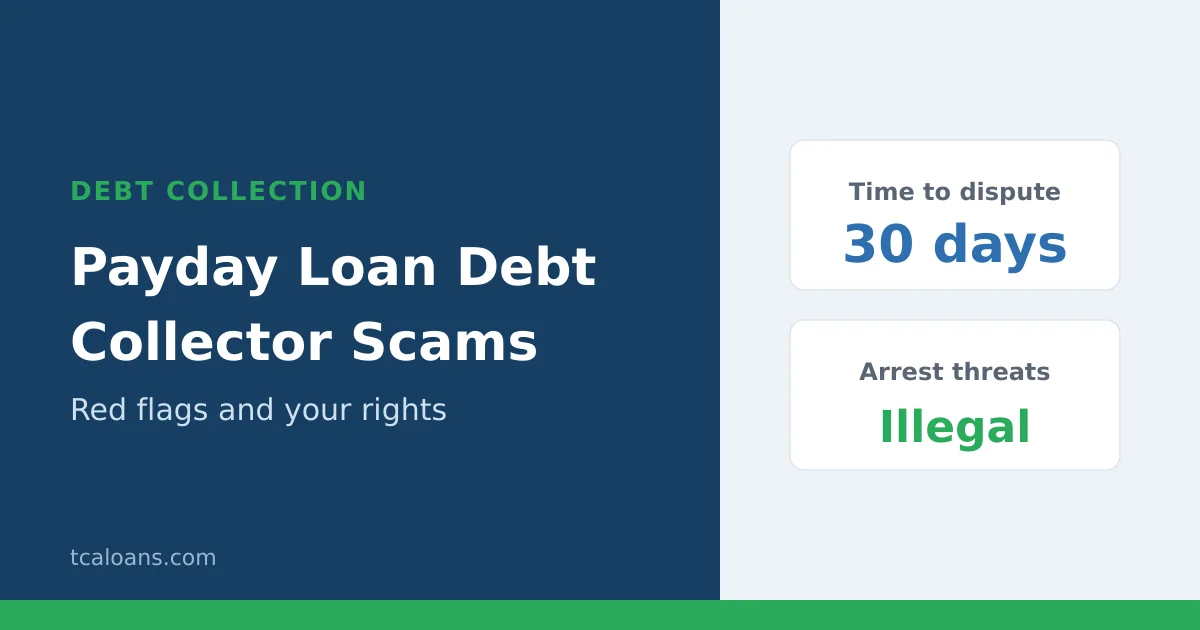
- A debt collector cannot have you arrested, or say you will be arrested, for an unpaid debt (CFPB).
- Collectors must give you validation information about the debt when they first contact you or within five days (CFPB; 15 U.S.C. 1692g).
- You have 30 days after receiving that information to dispute the debt, and the collector must stop collecting until it verifies it (CFPB).
- Refusing to give a mailing address or phone number, threats of criminal charges and requests for financial details are red flags (CFPB).
- You can report a suspected scam to the CFPB and the FTC.
Why payday borrowers are targeted
Fake collectors look for people who really did apply for a short term loan, because a call that names a real lender or a real application date sounds believable. If you once applied for a payday loan online, your name, phone number and the fact that you applied may have been shared with several companies. A caller who knows those details is not proof that you owe money to that caller. The only reliable test is whether the collector can give you the written information the law requires and whether that information matches your own records.
Red flags of a payday loan debt collector scam
| What the caller does | What the law or regulator says |
|---|---|
| Threatens arrest, jail or criminal charges | A collector may not threaten arrest or say you committed a crime (15 U.S.C. 1692e(4), (7); CFPB) |
| Says it will sue or garnish today but never names a court | A collector may not threaten action it cannot legally take or does not intend to take (15 U.S.C. 1692e(5)) |
| Refuses to give a company name, mailing address or phone number | A real collector should give its name, company, street address, phone and license number where your state requires one (CFPB) |
| Will not send anything in writing | Validation information is due at first contact or within five days (15 U.S.C. 1692g; 12 CFR 1006.34) |
| Asks for your bank login, full Social Security number or card number | Do not share financial details until you have verified the debt (CFPB) |
| Calls late at night, at work, or calls your family about the debt | Collectors are limited in when and where they contact you and who they talk to (15 U.S.C. 1692c; CFPB) |
| Uses a name that does not match any company you can look up | A collector may not use a name other than its true name (15 U.S.C. 1692e(14)) |
How to check whether the debt is real
- Ask for the caller’s name, company name, street address, phone number and, if your state licenses debt collectors, the license number (CFPB).
- Ask for the validation notice. It should name the creditor, the amount and the date by which you can dispute (12 CFR 1006.34).
- Compare it with your own records: the original lender, loan date, amount borrowed and payments made.
- Check the company with your state attorney general or financial regulator (CFPB). Our payday loan laws by state page lists the regulator for each state.
- If you do not recognize the debt, or think you already paid it, dispute it in writing within the 30 day window (CFPB).
- If you owe the debt, pay only the company you verified, through contact details you looked up yourself, and keep a receipt.
If the debt is real
A real payday debt does not disappear because a scammer also calls about it. A legitimate collector may sue you, and if you are sued you should respond by the deadline (CFPB). If the court orders you to appear and you do not, a judge may issue a warrant, which is the one way an unpaid debt can lead to an arrest (CFPB). Our guides on negotiating payday loan debt, time limits to sue in Texas and whether a lender can contact your employer cover the next steps.
What a payday loan costs
A typical payday loan charges about $15 per $100 borrowed (CFPB). Representative example: you borrow $300 for 14 days and pay a $45 fee, so you repay $345, an APR of about 391%. A scammer may quote a much larger balance with made-up fees; ask for the itemized amount in the validation notice and check it against your loan agreement. Run your own numbers in our payday loan cost and APR calculator.
Replacing payday debt with a lower cost loan
Once you have verified what you owe, some borrowers pay it off with a lower APR personal loan repaid in installments. If you want to compare offers, you can start from our personal loans page to be connected with independent lenders; the service is not available in Arkansas, New York, Vermont or West Virginia. Rates, fees and terms are set by the lender and depend on your credit and state; only refinance if the new APR and total cost are lower.
Where to report a payday loan debt collector scam
Report the caller to the CFPB and to the Federal Trade Commission, and to your state attorney general. Keep a log of each call: date, time, number, the name used and what was said. If you shared bank or card details, call your bank right away and ask about closing or monitoring the account.
Frequently asked questions
Can I go to jail for not paying a payday loan?
No, not for the debt itself. A collector cannot have you arrested or threaten arrest. A judge can issue a warrant only if you are sued and ignore a court order.
How do I know if a payday loan debt collector is real?
Ask for its name, company, street address, phone number and license number, and ask for the written validation notice. Then check the company with your state attorney general or regulator.
Should I give a debt collector my bank account number?
Not until you have verified the debt and the collector. A collector may ask for details like your date of birth or the last four digits of your Social Security number to confirm who you are.
How long do I have to dispute a payday loan debt?
30 days after you receive the validation information. The notice should state the end date. Once you dispute, the collector must stop collecting until it sends verification.
What if I already paid the payday loan?
Tell the collector in writing that you paid, send copies of your proof, and dispute the debt within the 30 day window.
Related reading
- Payday loan laws by state (2026)
- How much does a payday loan really cost? APR calculator
- How to negotiate payday loan debt
- Can a payday loan company contact my employer?
Sources
- CFPB, How do I tell if a debt collector is legitimate or a scam?
- CFPB, Can I be arrested for an unpaid debt?
- CFPB, Should I share personal information with a debt collector?
- CFPB, What can I do if a debt collector contacts me about a debt I already paid or don’t think I owe?
- CFPB, What should I do if I’m sued by a debt collector or creditor?
- CFPB, What is a payday loan?
- 15 U.S.C. 1692c, communication in connection with debt collection
- 15 U.S.C. 1692e, false or misleading representations
- 15 U.S.C. 1692g, validation of debts
- 12 CFR 1006.34, validation information (Regulation F)
- CFPB, Submit a complaint
- FTC, ReportFraud.ftc.gov
Last reviewed October 26, 2026 by the TCA Financial Editorial Team. Found an error? Email support@tcaloans.com.