What Happens If You Don’t Pay a Payday Loan in Texas?
By the TCA Financial Editorial Team. Last reviewed: October 27, 2026.
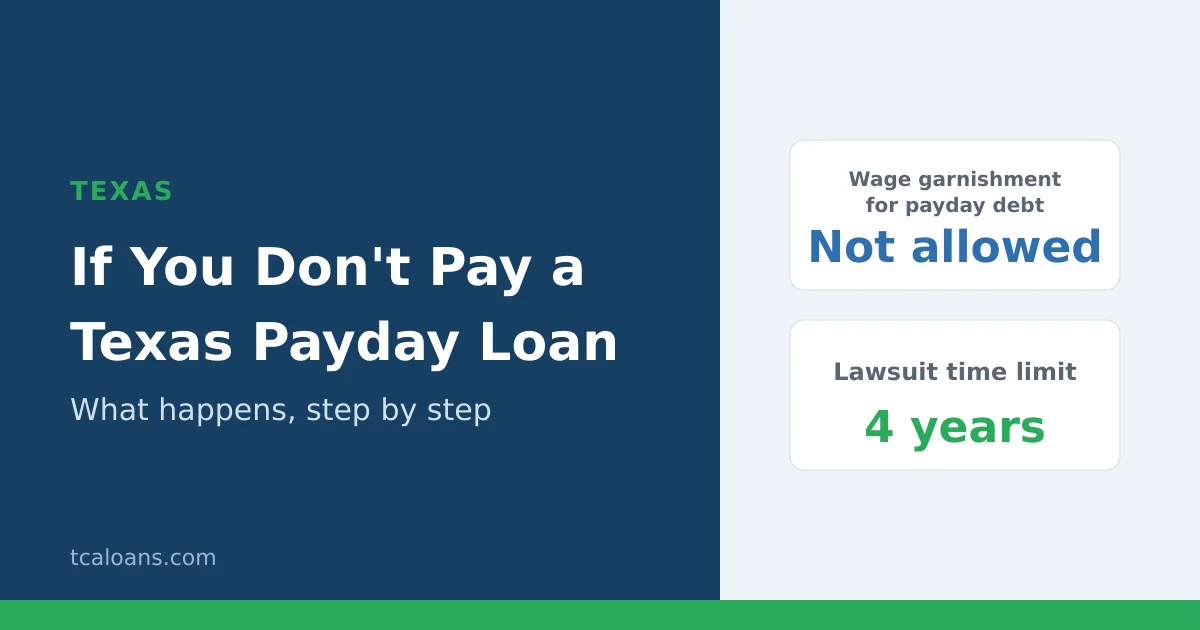
Short answer: If you don’t pay a payday loan in Texas, the lender will usually try to collect from your bank account, then offer a renewal with new fees, then send the debt to collections. It can sue you, and after a court judgment it can ask for a writ of garnishment on your bank account (Tex. Civ. Prac. & Rem. Code 63.001). It cannot garnish your current wages for this kind of debt (Tex. Prop. Code 42.001), and nobody may threaten or pursue criminal charges over the check or debit authorization you gave, unless there was forgery, fraud, theft or other criminal conduct (Tex. Fin. Code ch. 393).
Key points
- Most Texas payday loans are arranged by a credit access business (CAB) licensed by the Office of Consumer Credit Commissioner (OCCC).
- Current wages for personal services are exempt from seizure in Texas, except for court-ordered child support (Tex. Prop. Code 42.001(b)(1)).
- A creditor with a valid judgment can apply for a writ of garnishment, which can reach money in a bank account (Tex. Civ. Prac. & Rem. Code 63.001).
- Collectors may not threaten arrest without proper court proceedings or threaten criminal action when you have not broken a criminal law (Tex. Fin. Code 392.301).
- A late or charged-off debt can stay on your credit report for up to seven years (15 U.S.C. 1681c).
Step by step: what happens after a missed payment
| Stage | What usually happens | Your rights and options |
|---|---|---|
| Due date | The lender deposits your post-dated check or debits your account for the full amount | You can revoke a debit authorization, but you still owe the loan (CFPB) |
| Payment fails | Your bank may charge a non-sufficient funds fee, and the lender may try again | In a CFPB study, half of online payday borrowers paid an average of $185 in bank penalties (CFPB) |
| Renewal offer | The CAB offers to renew or refinance for another fee | Before the loan, the CAB must show what renewing for two weeks, one, two and three months would cost (Tex. Fin. Code 393.223) |
| Collections | Calls, letters, or a sale of the debt to a debt buyer | Texas bans threats of arrest without court proceedings and false criminal threats (Tex. Fin. Code 392.301) |
| Credit report | The account may be reported as a collection | Negative items generally drop off after seven years (15 U.S.C. 1681c) |
| Lawsuit | The lender or a debt buyer files a civil lawsuit | Respond by the deadline; check whether the four year time limit has passed (see our Texas statute of limitations guide) |
| Judgment and garnishment | The creditor asks the court for a writ of garnishment against your bank | Current wages are exempt (Tex. Prop. Code 42.001); two months of direct deposited federal benefits are protected (31 CFR 212.6) |
Can you go to jail for not paying a payday loan in Texas?
Not for failing to pay. Texas law requires the CAB contract to state that a person may not threaten or pursue criminal charges against a consumer related to a check or debit authorization given as security for the loan, in the absence of forgery, fraud, theft or other criminal conduct (Tex. Fin. Code ch. 393). Texas debt collection law also bars threatening arrest without proper court proceedings and threatening criminal action when you have not violated a criminal law (Tex. Fin. Code 392.301(a)(5), (6)). The one way a debt case can lead to a warrant is ignoring a court order after you are sued, so never ignore court papers (CFPB). If a caller threatens jail, read our guide to payday loan debt collector scams.
Can a payday lender garnish your wages in Texas?
No. Current wages for personal services are exempt from garnishment, attachment, execution or other seizure in Texas, except to enforce court-ordered child support (Tex. Prop. Code 42.001(b)(1)). That protection is about your paycheck from your employer. Once you have a judgment against you, the creditor can ask for a writ of garnishment, and a bank account is the usual target (Tex. Civ. Prac. & Rem. Code 63.001). If federal benefits such as Social Security are direct deposited, your bank must protect two months of those deposits (31 CFR 212.6). Our article on whether a payday loan can freeze your bank account explains how that works.
What to do if you can’t pay
- Call the CAB before the due date and ask about a payment plan or more time (CFPB).
- Before you renew, compare the renewal fee with the amount you owe. Renewing again and again can cost more than the original loan.
- If you decide to stop automatic payments, revoke the authorization with the lender and your bank in writing (CFPB).
- Keep every letter and write down each call: date, name and what was said.
- If you are sued, file an answer by the deadline and raise any defenses, such as the time limit (CFPB).
- If a CAB or collector breaks the rules, file a complaint with the Texas OCCC.
For a plan to settle or reduce what you owe, see how to negotiate payday loan debt. To learn whether a lender can call your workplace, see can a payday loan company contact my employer.
What it costs if you keep renewing
A typical payday loan charges about $15 per $100 borrowed (CFPB); Representative example: you borrow $300 for 14 days and pay a $45 fee, so you repay $345, an APR of about 391%. If you cannot pay and renew four times at the same fee, you pay $180 in fees and still owe the $300. Run your own numbers in our payday loan cost and APR calculator, and compare Texas with other states in payday loan laws by state.
Replacing a payday loan with a lower cost loan
Some Texas borrowers pay off payday debt with a lower APR personal loan repaid in installments. If you want to compare offers, you can start from our personal loans page to be connected with independent lenders; the service is not available in Arkansas, Connecticut, Georgia, Illinois, Massachusetts, Minnesota, New Hampshire, New York, North Dakota, Vermont or West Virginia. Rates, fees and terms are set by the lender and depend on your credit and state; only refinance if the new APR and total cost are lower.
Frequently asked questions
What happens if I just stop paying my payday loan in Texas?
The lender will try to collect from your bank account, then by calls and letters, and may sell the debt or sue you. Fees and bank charges can add up, and the debt can hurt your credit.
Can a payday loan company take me to court in Texas?
Yes. It can file a civil lawsuit, generally within four years. If it wins, it can ask for a writ of garnishment against your bank account.
Can they take money from my bank account without a court order?
Only through payments you authorized, such as a post-dated check or automatic debit. Garnishing an account requires a judgment and a court writ.
Will I be arrested for an unpaid payday loan in Texas?
No, not for the debt itself. Threatening arrest without proper court proceedings is banned in Texas. A warrant can only follow if you ignore a court order in a lawsuit.
Does an unpaid payday loan go on my credit report?
It can, if the lender or a collector reports it. Negative items generally stay on your report for up to seven years.
Related reading
- Payday loan statute of limitations in Texas
- Payday loan laws by state (2026)
- How much does a payday loan really cost? APR calculator
- Payday loan debt collector scams
Sources
- Texas OCCC, Credit access businesses
- Texas Finance Code ch. 393, credit services organizations and credit access businesses
- Texas Finance Code ch. 392, debt collection
- Texas Property Code ch. 42, personal property exemptions
- Texas Civil Practice and Remedies Code ch. 63, garnishment
- 31 CFR 212.6, protected amount of federal benefits
- 15 U.S.C. 1681c, information excluded from consumer reports
- CFPB, What is a payday loan?
- CFPB, What can I do if I can’t repay my payday loan?
- CFPB, How can I stop a payday lender from electronically taking money out of my account?
- CFPB, What should I do if I’m sued by a debt collector or creditor?
- CFPB, Half of online payday borrowers rack up an average of $185 in bank penalties (2016)
- Texas OCCC, File a complaint
Last reviewed October 27, 2026 by the TCA Financial Editorial Team. Found an error? Email [email protected].
Disclosure: TCA Financial (tcaloans.com) is not a lender and does not make credit decisions. We connect people with independent lenders and may be paid by those lenders for advertising. This guide is general information, not legal, tax or financial advice. A nonprofit credit counselor, legal aid office or tax professional can tell you how it applies to you.